In the present case I can testify as follows:
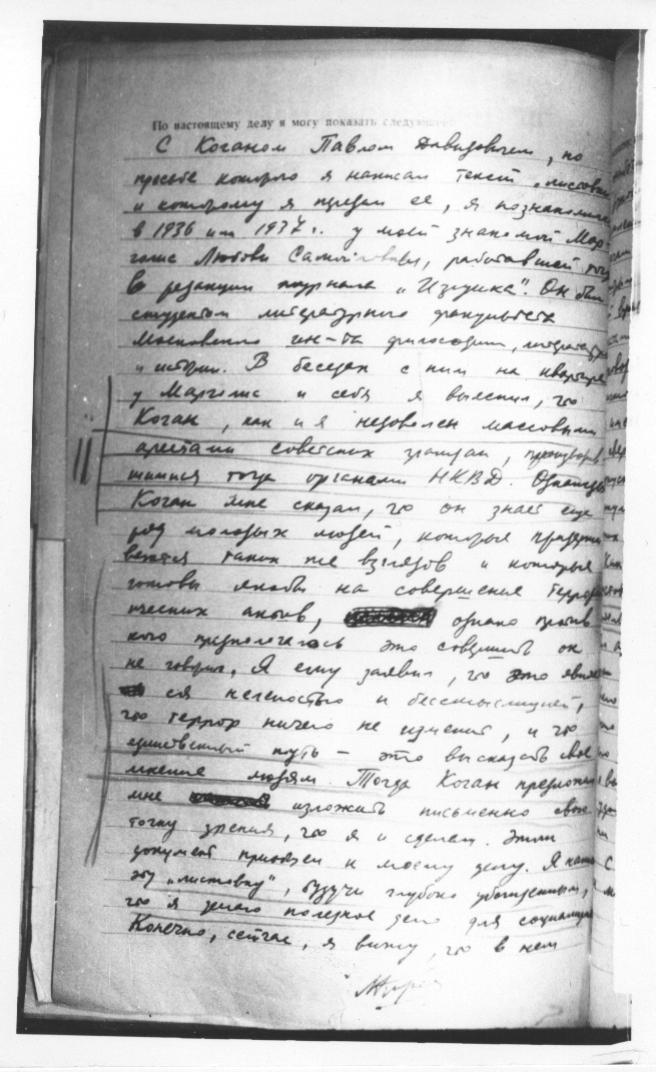
With Pavel Davydovich Kogan, at
whose request I wrote the text of the leaflet
and which I handed it over, I became acquainted
in 1936 or 1937 at my acquaintance Mar-
galita Lvovna [illegible], who worked th-
en on the editorial staff of the journal "Kuznitsa". He was
a student of the literature faculty
[illegible] inst. of philosophy, history
and [illegible]. In conversations with him, in the apartment
at [illegible] and my own, I found out that
Kogan, like me, was dissatisfied with the mass
arrests of Soviet citizens, being car-
ried out then by the organs of the NKVD. Once
Kogan told me that he knows still
a number of young people whom [illegible]
[illegible] had not earlier drawn in and who
wanted to know, for the commission of sta-
te acts, [illegible] however [illegible]
who [illegible] committed this he
did not say. I declared to him that this is connected
[illegible] with slander and is senseless,
that terror will improve nothing, and that
the only path - is to state one's
opinion to the masses. Then Kogan proposed
to me [illegible] to set out in writing my [illegible]
point of view, which I did. By this
[illegible] used to bring to my house. I began
this "leaflet", being deeply convinced
that I am able to set this out so [illegible]
[illegible], now, I see that in whom
[illegible]
Korets
[in the margin] 158
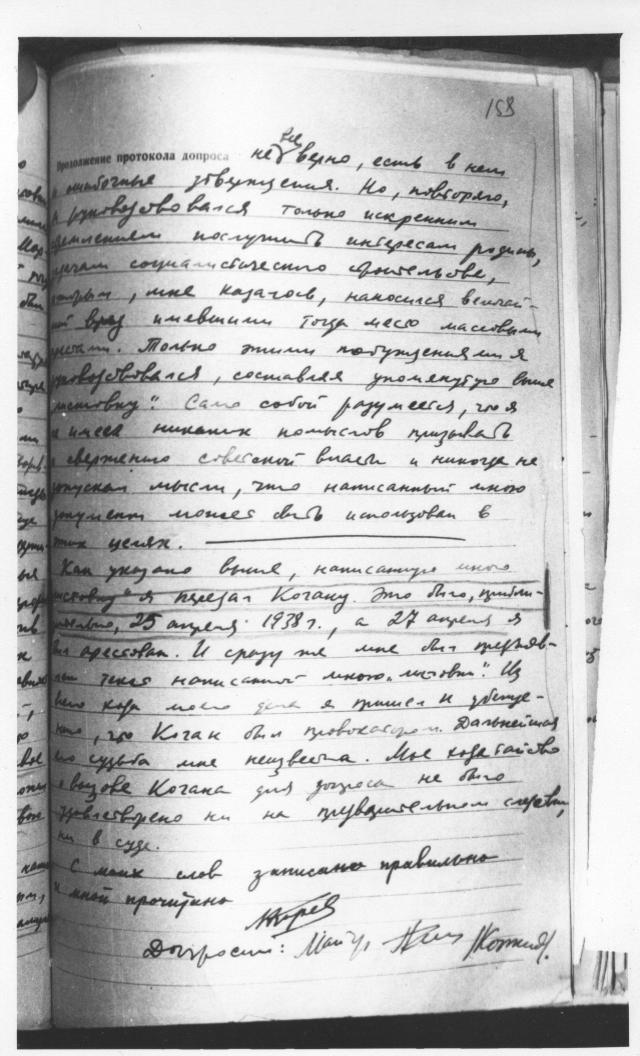
Continuation of the interrogation record
[illegible] not sure, there is in whom
[illegible] of incitement. No, again,
I was guided only by a sincere
[illegible] to serve the interests of the motherland,
[illegible] accord[illegible] [illegible],
[illegible], it seemed to me, there was being inflicted grea-
[illegible] harm by the mass
arrests that were taking place then. It was precisely by these motives that I
was guided in drawing up the above-mentioned
leaflet. It goes without saying that I
among no counter[illegible] calls for
the overthrow of Soviet power and never
allowed the thought that the document written by me
might be used for
these purposes.
As stated above, the leaflet written by me
I handed to Kogan. This was, ap-
[illegible], 25 April 1938, and on 27 April I
was arrested. And at once there was present-
ed to me the text of the leaflet written by me. From
[illegible] how it could be I came to the convict-
ion that Kogan was a provocateur. Further
his [illegible] are unknown to me. To me still [illegible]
about the summoning of Kogan for interrogation there was not
[illegible] neither at the preliminary investig-
ation in court.
Recorded correctly from my words
and read by me
Korets
Interrogated by: [illegible], [illegible] /Korkin/
P.159 Interrogation record of 27.06.56 verso p. 160
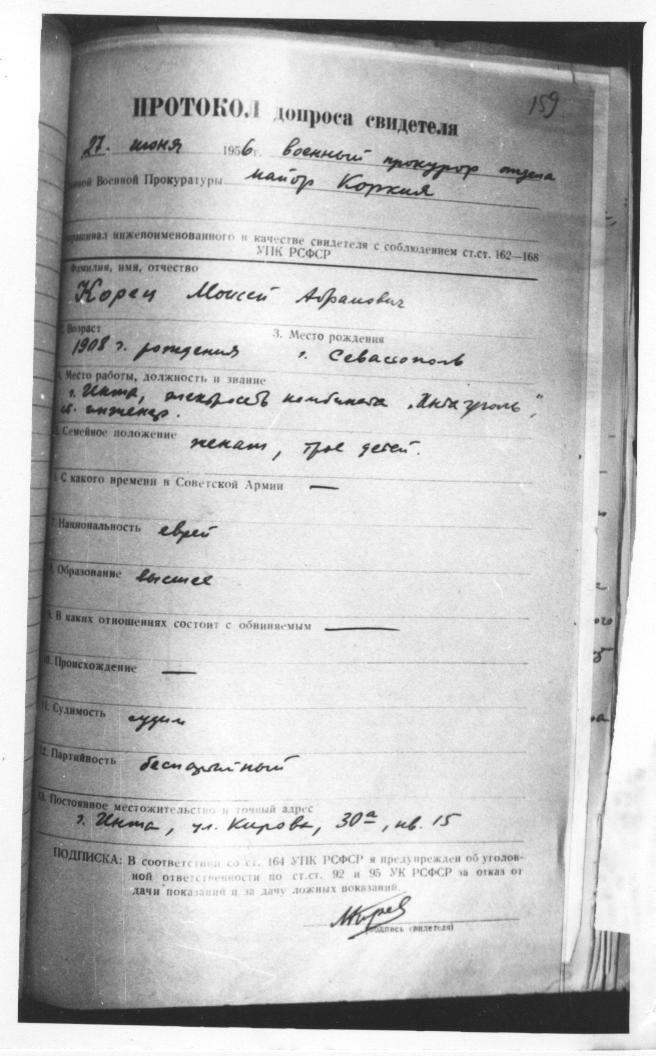
RECORD of the interrogation of a witness
[in the margin] 159
27 June 1956 military prosecutor [illegible]
Major Korkin
[illegible] of the Military Prosecutor's Office
interrogated the person named below as a witness in compliance with Arts. 162-168
of the Crim. Proc. Code of the RSFSR
Surname, first name, patronymic
Korets Moisey Abramovich
Age
born in 1908
Place of birth
the city of Sevastopol
Place of work, post and rank
the city of Inta, electr[illegible] of the combine "Intaugol",
sr. engineer.
Marital status
married, three children.
Since what time in the Soviet Army
—
Nationality
Jew
Education
higher
In what relation he stands to the accused
—
Origin
—
Criminal record
convicted
Party membership
non-party
Permanent residence and exact address
the city of Inta, Kirov St., 30a, apt. 15
UNDERTAKING: In accordance with Art. 164 of the Crim. Proc. Code of the RSFSR I have been warned of crimin-
al liability under Arts. 92 and 95 of the Crim. Code of the RSFSR for refusal to
give testimony and for giving false testimony.
Korets
(signature of the witness)
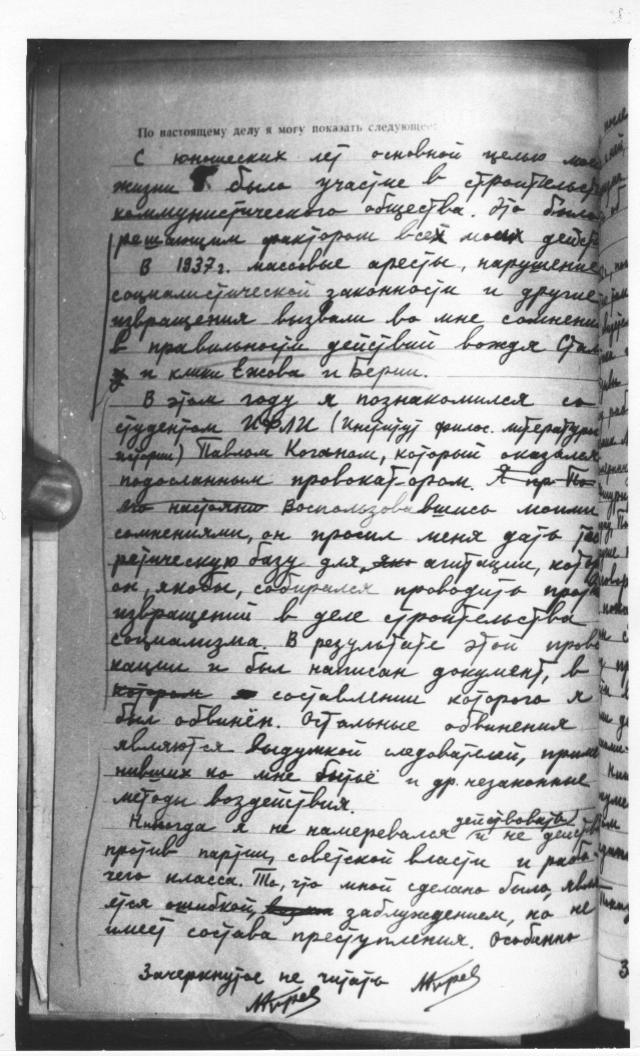
In the present case I can testify as follows:
From my youth the principal aim of my
life was participation in the building
of a communist society. But more
the decisive factor of all my actions
In 1937 mass arrests, the violation
of socialist legality and other
perversions aroused in me doubts
as to the correctness of the actions of the leader Sta-
lin and of the clique of Yezhov and Beria.
In this year I became acquainted with
a student of IFLI (institute of philosoph. literature
[illegible]) Pavel Kogan, who turned out to be
a planted provocateur. I showed
toward him a certain [illegible] with my
doubts, he asked me to give [illegible]
a factual basis for these doubts, whic
h, supposedly, he was going to conduct against
perversions in the work of building
socialism. As a result of this provo-
cation a document was written, in
which [illegible] socialism of which I
was accused. The remaining charges
are an invention of the investigators, appl-
ied to me beating and oth. unlawful
methods of pressure.
Never did I intend [illegible] to act
against the party, Soviet power and the wor-
king class. What had been done by me i
s an error, [illegible] a delusion, but does not
contain the elements of a crime. Especially
Do not read what is crossed out Korets
Korets
[illegible]
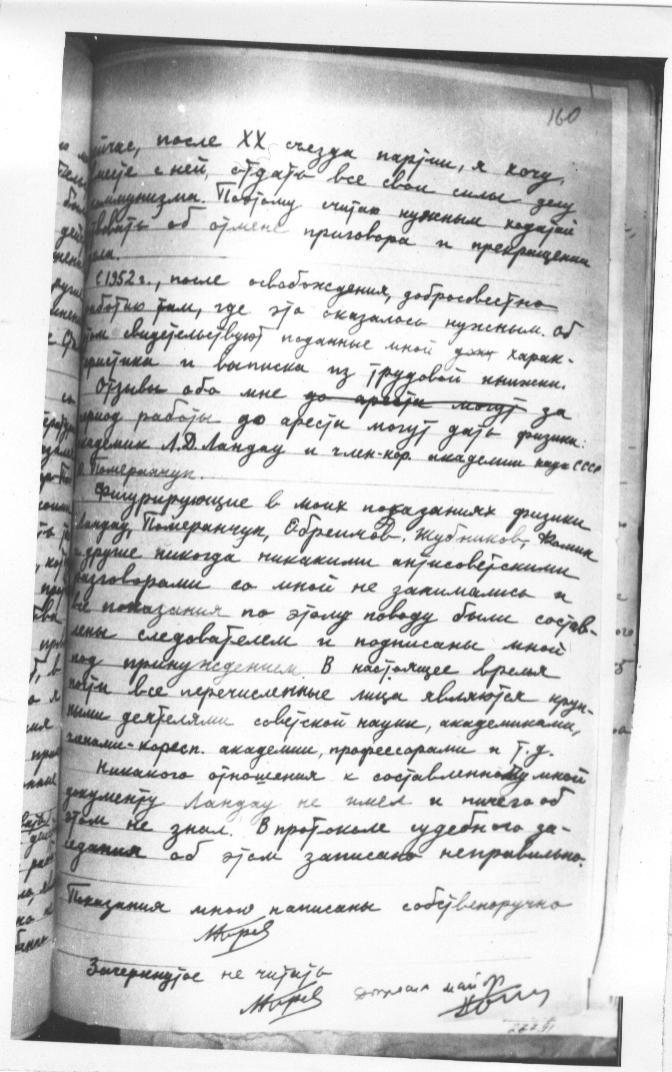
[in the margin] 160
[illegible], after the XX Congress of the Party, I want
[illegible] with it, to give all my strength to the cause
of communism. Therefore I write to the judicial authorities
a request for the setting aside of the sentence and the discontinuance
[illegible].
Since 1952, after my release, conscientiously
I work where this proved necessary. Of
this there bear witness the [illegible] refer-
ence submitted by me and extracts from the employment record book.
Opinions about me before the arrest can be given by the physicists
Academician L.D. Landau and Corr. Member of the Academy of Sciences [illegible]
Tamm [illegible].
The physicists figuring in my testimony
Landau, Tamm, [illegible], Shubnikov, [illegible]
and others never engaged in any anti-Soviet
conversations with me and
their testimony on this matter was comp
osed by the investigator and signed by me
under compulsion. At the present time
almost all the persons listed are prom-
inent figures of Soviet science, academicians,
corr. members of the Academy, professors etc.
Landau had no relation to the drawing up by me
of the document and knew nothing
about this. In the record of the court ses-
sion this is recorded incorrectly.
The testimony was written by me in my own hand
Korets
Do not read what is crossed out
Korets
[illegible] /Korkin/
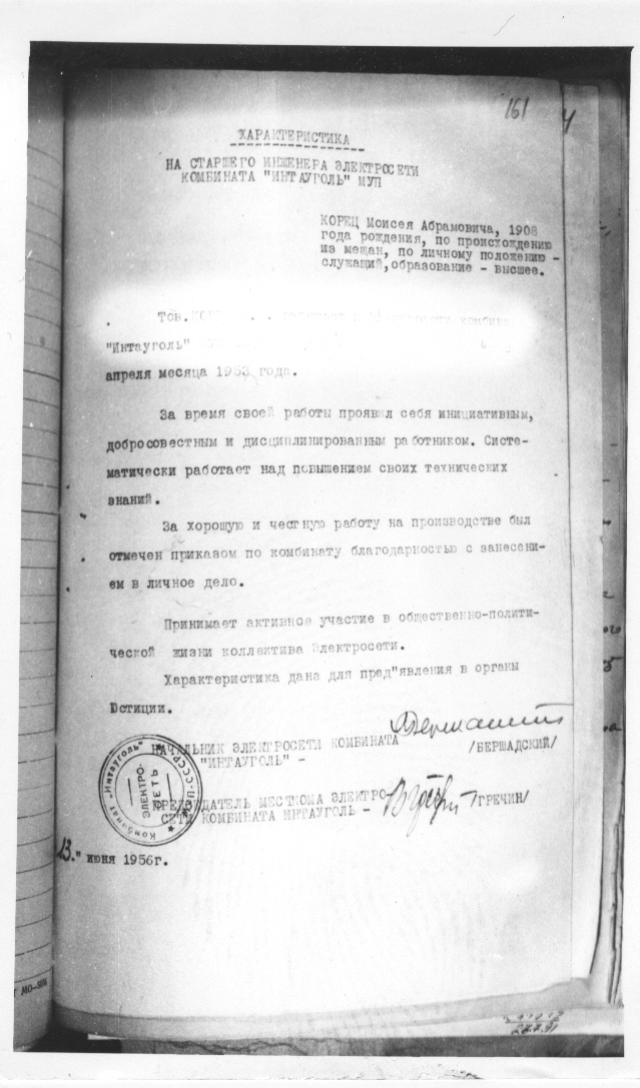
P.161 Reference for the senior engineer of the Intaugol power grid
[in the margin] 161
REFERENCE
FOR THE SENIOR ENGINEER OF THE POWER GRID
OF THE COMBINE "INTAUGOL" MUP
KORETS Moisey Abramovich, 1908
year of birth, by origin
from the townspeople, by personal status -
an employee, education - higher.
Comr. Korets [illegible] of the combine
"Intaugol"
of the month of April 1956.
During the time of his work he showed himself an enterprising,
conscientious and disciplined worker. System-
atically he works at raising his technical
knowledge.
For good and honest work in production he was
noted by an order for the combine with a commendation entered
in his personal file.
He takes an active part in the social-polit-
ical life of the power-grid collective.
The reference is given for presentation to the organs
of Justice.
[illegible] /VERSHADSKY/
[seal] [illegible] OF THE POWER GRID OF THE COMBINE "INTAUGOL"
[illegible] /GRECHIN/
"13" June 1956
P. 162 Extract from the employment record book
[in the margin] 161
REFERENCE
FOR THE SENIOR ENGINEER OF THE POWER GRID
OF THE COMBINE "INTAUGOL" MUP
KORETS Moisey Abramovich, 1908
year of birth, by origin
from the townspeople, by personal status -
an employee, education - higher.
Comr. Korets [illegible] of the combine
"Intaugol"
of the month of April 1956.
During the time of his work he showed himself an enterprising,
conscientious and disciplined worker. System-
atically he works at raising his technical
knowledge.
For good and honest work in production he was
noted by an order for the combine with a commendation entered
in his personal file.
He takes an active part in the social-polit-
ical life of the power-grid collective.
The reference is given for presentation to the organs
of Justice.
[illegible] /VERSHADSKY/
[seal] [illegible] OF THE POWER GRID OF THE COMBINE "INTAUGOL"
[illegible] /GRECHIN/
"13" June 1956
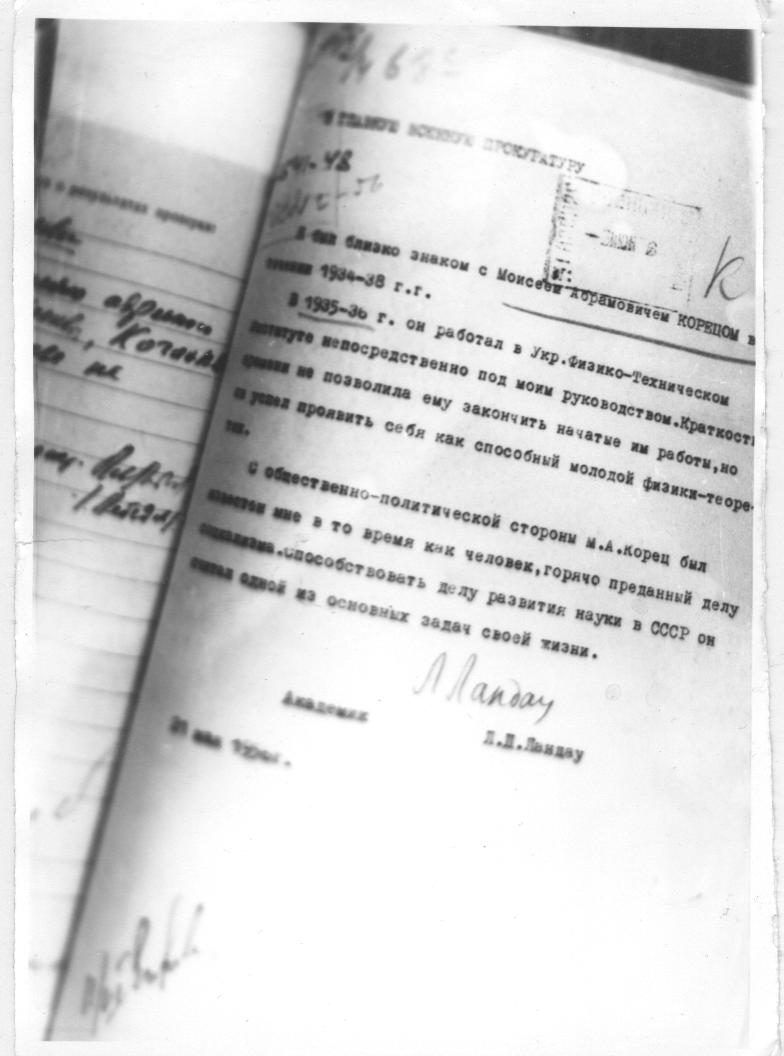
Landau’s letter to the Central Military Prosecutor’s Office
A reading of the photograph, uncertain in places. Check it against the photograph.
[in the margin] [illegible]
[in the margin] 54.48
[in the margin] [illegible]
[seal] [illegible]
[in the margin] K
TO THE CHIEF MILITARY PROSECUTOR'S OFFICE
I was closely acquainted with Moisey Abramovich KORETS during
the course of 1934-38.
In 1935-36 he worked at the Ukr. Physico-Technical
Institute directly under my direction. The brevity
[illegible] did not allow him to finish the work he had begun, but
he managed to show himself as a capable young physicist-theore-
tician.
From the social-political side M.A. Korets was
known to me at that time as a man fervently devoted to the cause
[illegible] to further the cause of the development of science in the USSR he
considered one of the principal tasks of his life.
L. Landau
Academician
L.D. Landau
21 May 1956
[in the margin] [illegible]
[in the margin] Korets
[in the margin] [illegible]
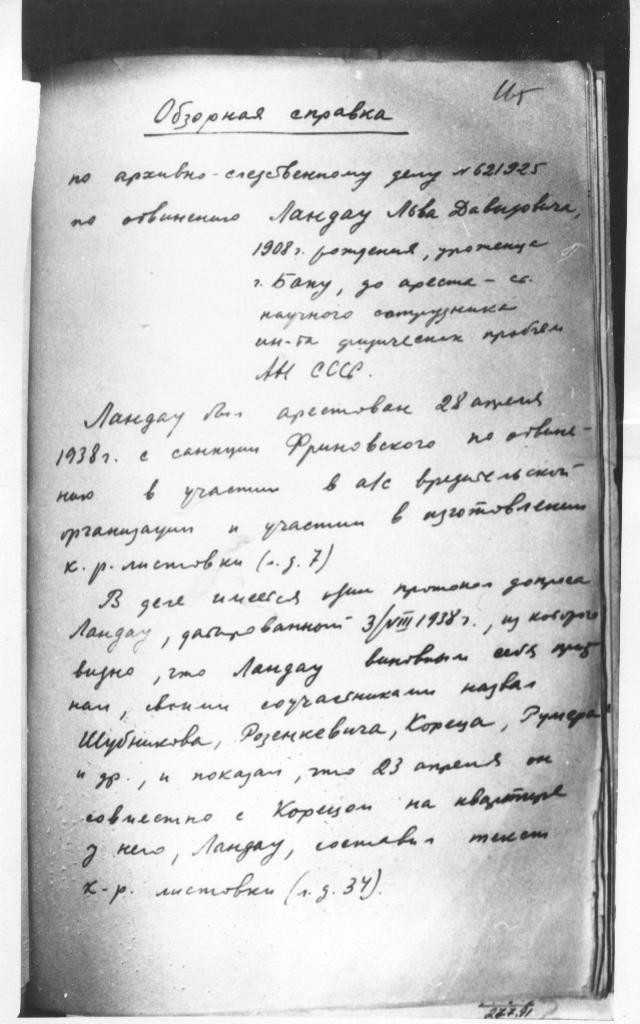
P. 165 Survey report on the charge against Landau p. 166
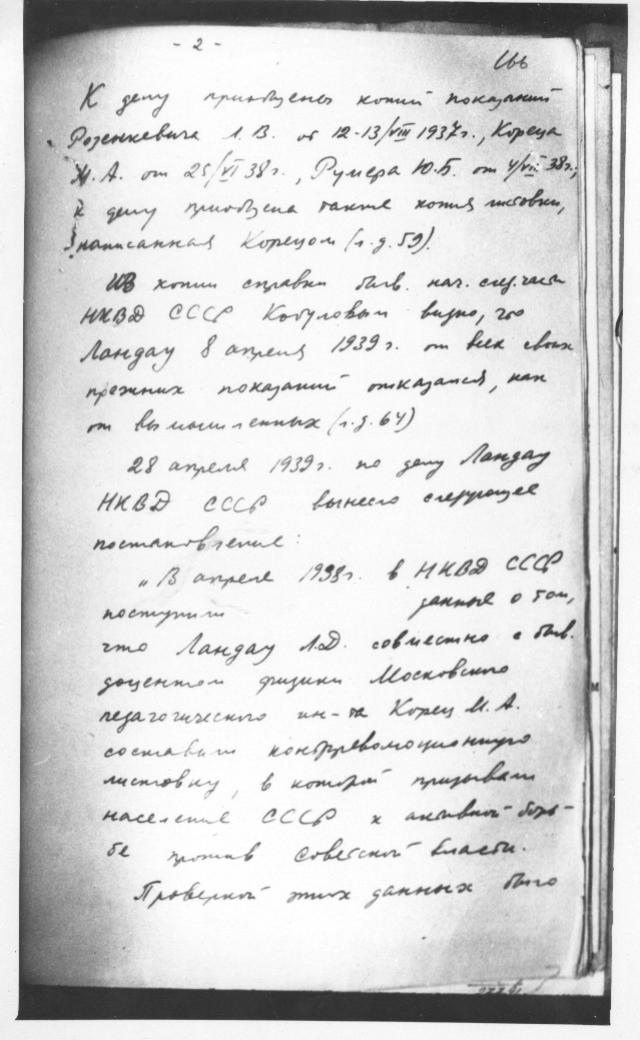
Survey report
[in the margin] 165
on archival-investigation case No. 621325
on the charge against Lev Davidovich Landau,
born in 1908, a native
of the city of Baku, before arrest - sen.
scientific worker
of the Inst. of Physical Problems
of the AS USSR.
L.D. Landau was arrested on 28 April
1938 with the sanction of Frinovsky on the char-
ge of participation in an a/s wrecking
organization and participation in the making
of a c.r. leaflet (ld. 7)
In the case there is one interrogation record
of Landau, dated 3/VIII 1938, from which
it is evident that Landau confessed himself gui-
lty, named as his accomplices
Shubnikov, Rozenkevich, Korets, Rumer
and others, and testified that on 23 April he
together with Korets in the apartment
at his, Landau’s, drew up the text
of a c.r. leaflet (ld. 34).
- 2 -
[in the margin] 166
Appended to the case are copies of the testimony
of L.V. Rozenkevich of 12-13/VII 1937, of Korets
M.A. of 25/V 38, of Yu.B. Rumer of [illegible] 38.
Also appended to the case is a copy of the leaflet
written by Korets (ld. 53).
From the copy of the note of Dep. People's [illegible]
of the NKVD of the USSR Kobulov it is evident that
Landau on 8 April 1939 withdrew all his
former testimony, as
from forced ones (ld. 61)
On 28 April 1939 in the case of Landau
the NKVD of the USSR issued the following
order:
"In April 1938 there came into the NKVD of the USSR
information to the effect
that L.D. Landau together with [illegible]
[illegible] of physics of the Moscow
Pedagogical Inst. M.A. Korets
drew up a counterrevolutionary
leaflet in which they called
the population of the USSR to an active strug-
gle against Soviet power.
A check of these data [illegible]
P. 167 p.169
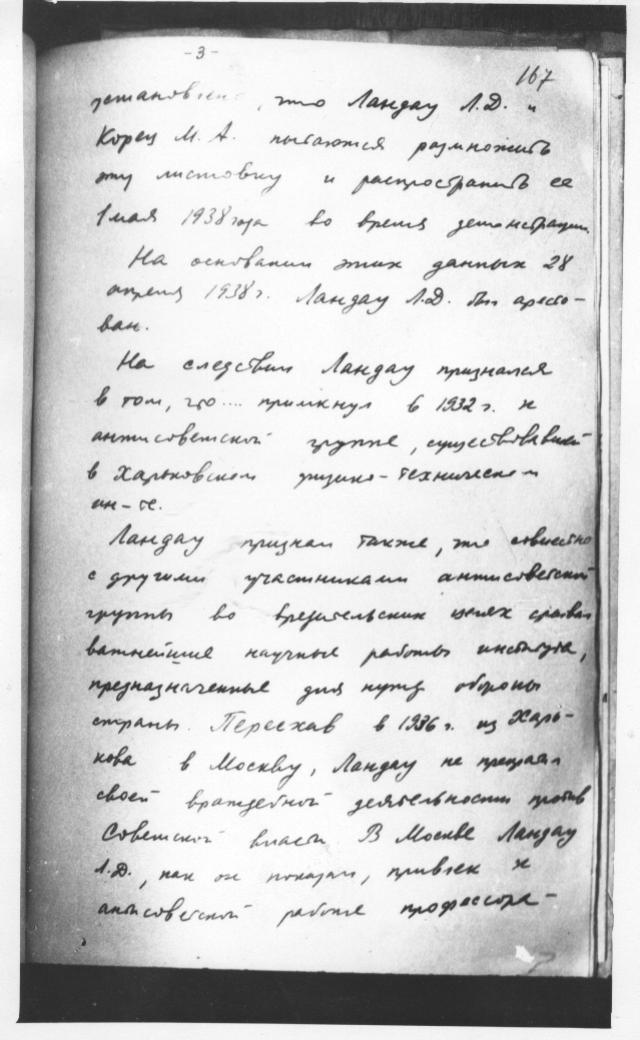
- 3 -
[in the margin] 167
it was established that L.D. Landau and
M.A. Korets are trying to make copies of
this leaflet and to distribute it
on 1 May 1938 during the demonstration.
On the basis of these data, on 28
April 1938 L.D. Landau was arres-
ted.
At the investigation Landau confessed
that he had joined in 1932
an anti-Soviet group that exis-
ted at the Kharkov Physico-Technic-
al Inst.
Landau also admitted that together
with other participants of the anti-Soviet
group, for wrecking purposes, he disrupted
the most important scientific work of the institute
intended for the needs of the defense
of the country. Having moved in 1936 from Khar-
kov to Moscow, Landau did not cease
his hostile activity against
Soviet power. In Moscow Landau
L.D., as he testified, drew into
anti-Soviet work a progressiv-
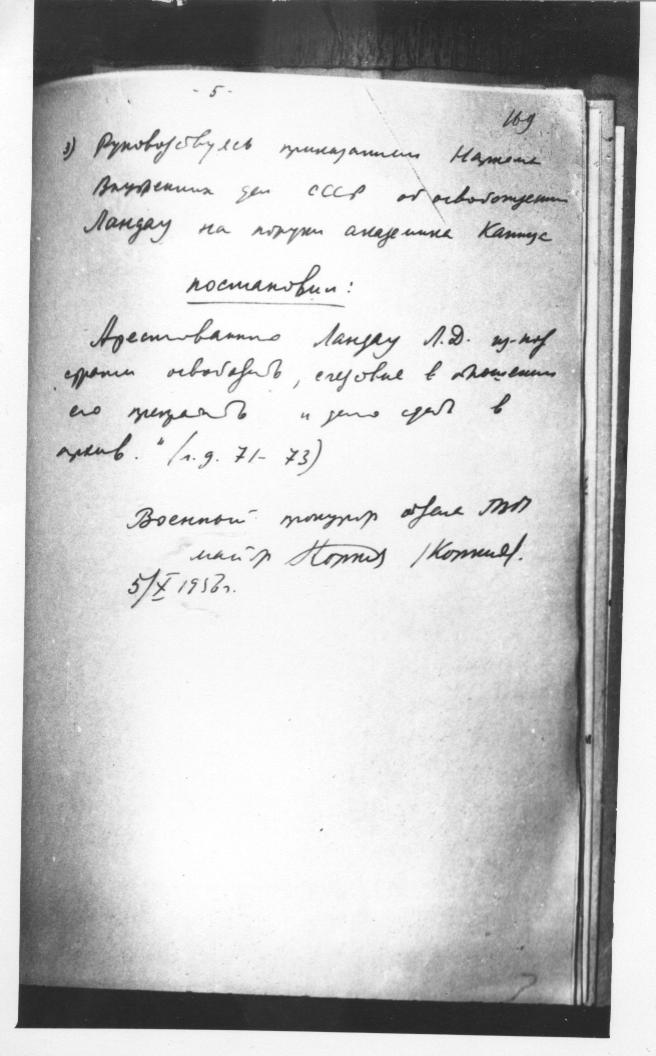
- 5 -
[in the margin] 169
3) Guided by the order of the People's Commissar
of Internal Affairs of the USSR to release
Landau on the surety of Academician Kapitsa
resolved:
The arrested L.D. Landau from under
custody to release, handing him over on the surety
[illegible] to Academician Kapitsa "so that in the
furth." (ld. 71-73)
Military prosecutor of the GVP department
Major [illegible] /Korkin/
3/X 1958
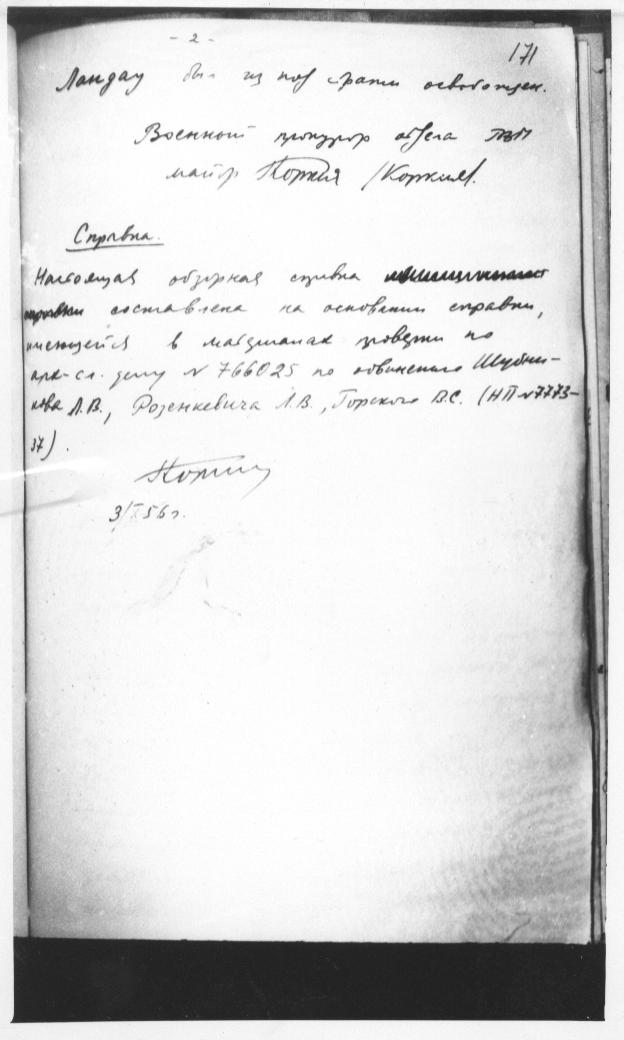
P. 171 Note
- 2 -
[in the margin] 171
L.D. Landau has been released from under custody.
Military prosecutor of the GVP department
Major [illegible] /Korkin/.
Note.
The present survey report [illegible]
was drawn up on the basis of the note
present in the materials of the check on
arch.-inv. case No. 766025 on the charge against Shubni-
kov L.V., Rozenkevich L.V., Gorsky V.S. (NT No. [illegible]
37).
[illegible]
3/X 56
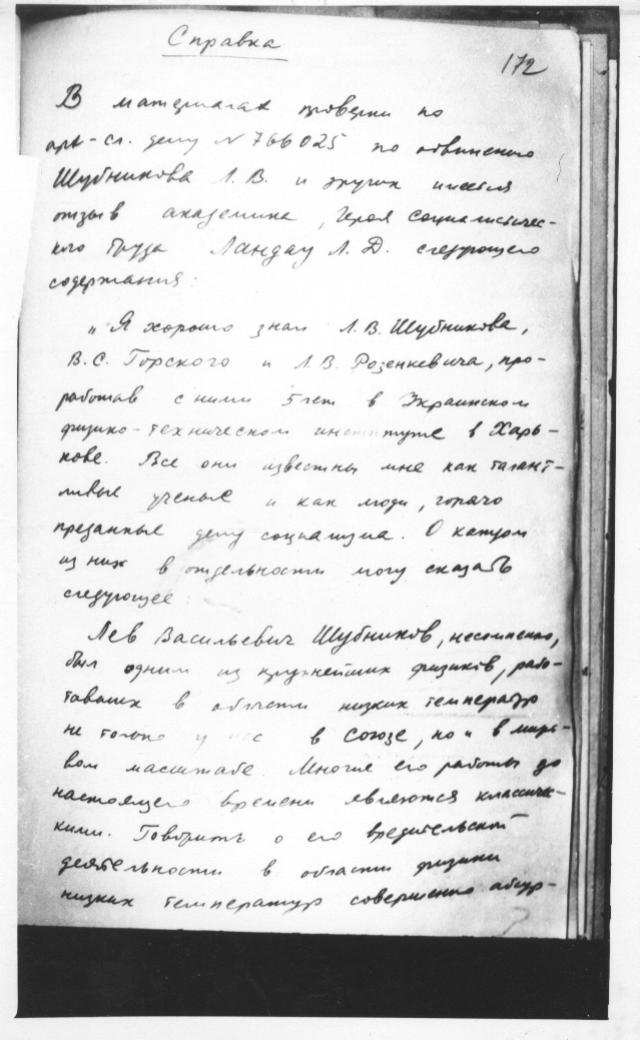
P. 172 Note on the review of the charge against Shubnikov and others. Landau’s letter p. 173 p. 174
Note
[in the margin] 172
In the materials of the check on
arch.-inv. case No. 766025 on the charge
against L.V. Shubnikov and others there is
an opinion of Academician, Hero of Socialis-
t Labor L.D. Landau, of the following
content:
"I knew well L.V. Shubnikov,
V.S. Gorsky and L.V. Rozenkevich, having wor-
ked with them 3 years at the Ukrainian
Physico-Technical Institute in Khar-
kov. All of them are known to me as talen-
ted scientists and as people fervently
devoted to the cause of socialism. Of each
of them separately I can say
the following
Lev Vasilyevich Shubnikov, undoubtedly,
was one of the greatest physicists wor-
king in the field of low temperatures
not only here in the Union, but also on a wor-
ld scale. Many of his works up to
the present time are class-
ical. To speak of his wrecking
activity in the field of the physics
of low temperatures is entirely absur-
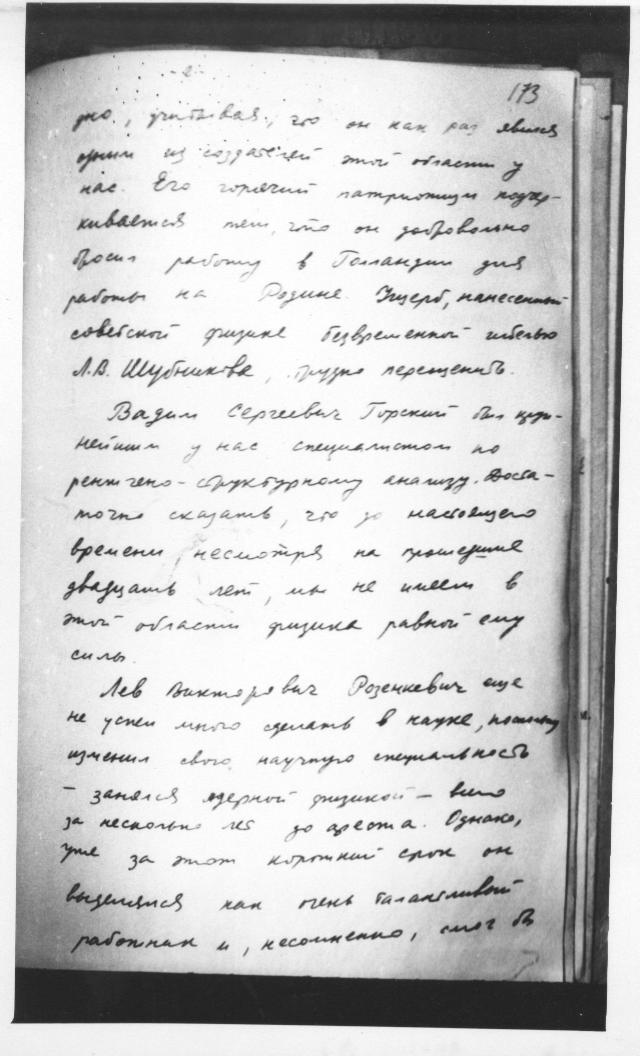
- 2 -
[in the margin] 173
d, considering that he precisely was
one of the creators of this field with
us. His level of strain scien-
kivalsya in that he conceived
his work in Holland for
work in the Motherland. The death inflicted
on Soviet physics by the untimely perishing
of L.V. Shubnikov is hard to overestimate.
Vadim Sergeevich Gorsky was the grea-
test specialist we had in
X-ray structural analysis. It is pos-
sible to say that up to the present
time, despite the twenty
years that have passed, we do not have in
this field of physics a force equal to
his.
Lev Viktorovich Rozenkevich still
had not managed to do much in science, because
he changed his scientific specialty
- he took up nuclear physics - only
a few years before his arrest. However,
already in this short time he
came forward as a very talented
worker and, undoubtedly, had in
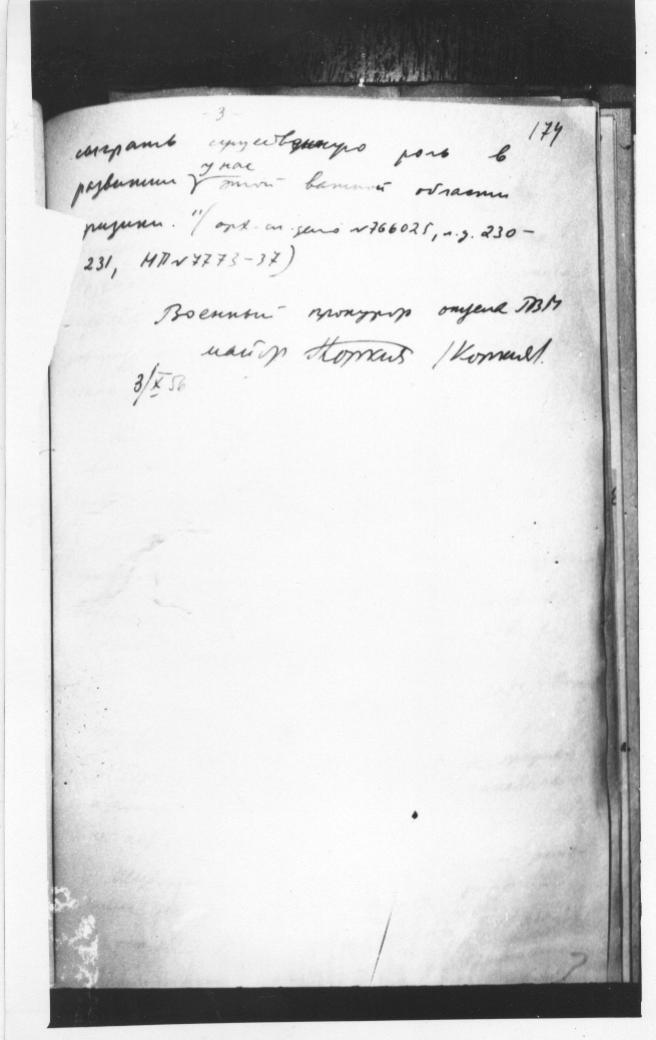
- 3 -
[in the margin] 174
[illegible] there existed a role in
the development with us of this important field
of physics. (arch. inv. case No. 766025, ld. 230-
231, NT No. [illegible]-37)
Military prosecutor of the GVP department
Major [illegible] /Korkin/
3/X 56
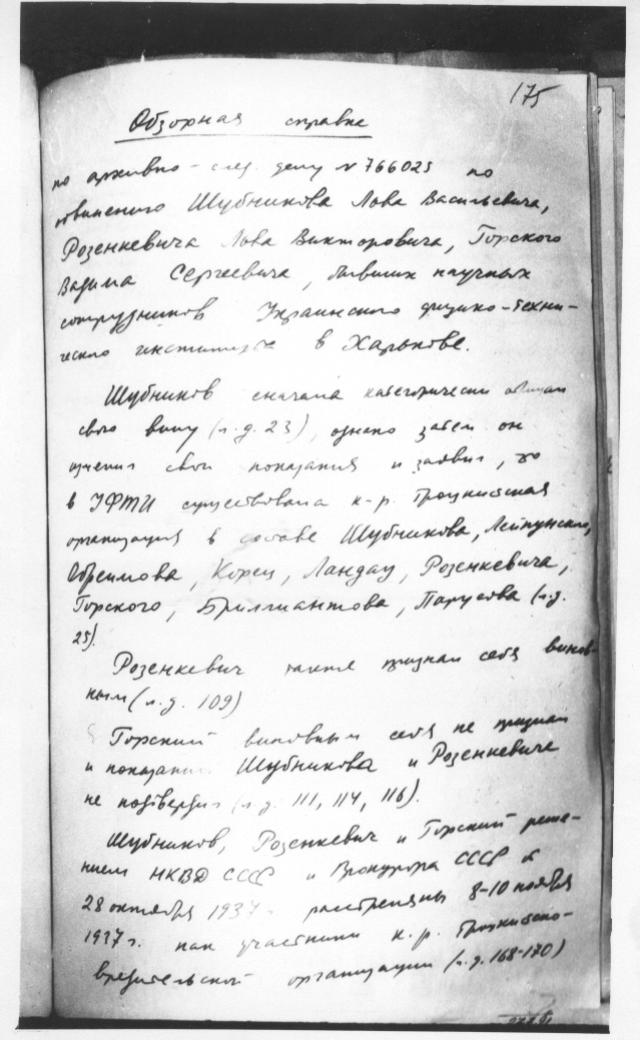
P. 175 Survey report on the charge against Shubnikov, Rozenkevich, Gorsky
Survey report
[in the margin] 175
on arch.-investig. case No. 766025 on
the charge against Lev Vasilyevich Shubnikov,
Lev Viktorovich Rozenkevich, Gorsky
Vadim Sergeevich, former scientific
workers of the Ukrainian Physico-Technic-
al Institute in Kharkov.
Shubnikov at first categorically denied
his guilt (ld. 23), however then he
specified his testimony and stated that
at UFTI there existed a c.-r. Trotskyist
organization consisting of Shubnikov, Leipunsky,
[illegible], Korets, Landau, Rozenkevich,
Gorsky, Brilliantov, [illegible] (ld.
25)
Rozenkevich also confessed himself guil-
ty (ld. 109)
Gorsky did not confess himself guilty
and did not confirm the testimony of Shubnikov and Rozenkevich
(ld. 111, 114, 116).
Shubnikov, Rozenkevich and Gorsky by a deci-
sion of the NKVD of the USSR and the Prosecutor of the USSR of
28 October 1937 were shot on 8-10 November
1937 as participants in a c.r. Trotskyist-
wrecking organization (ld. 168-180)
P. 184 Interrogation p.185 verso p.186 verso p. 187 verso
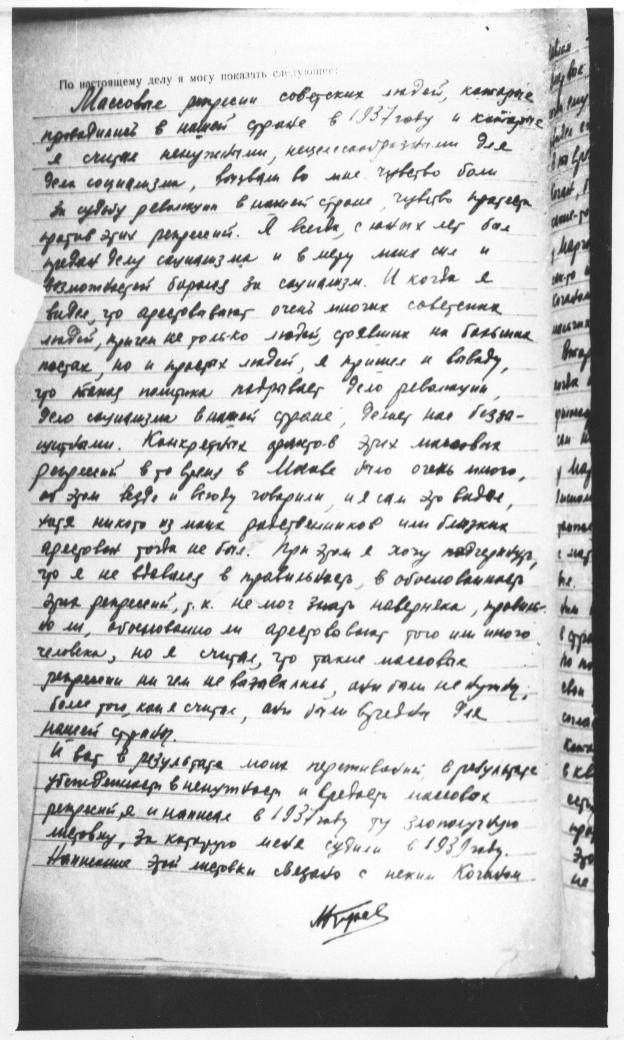
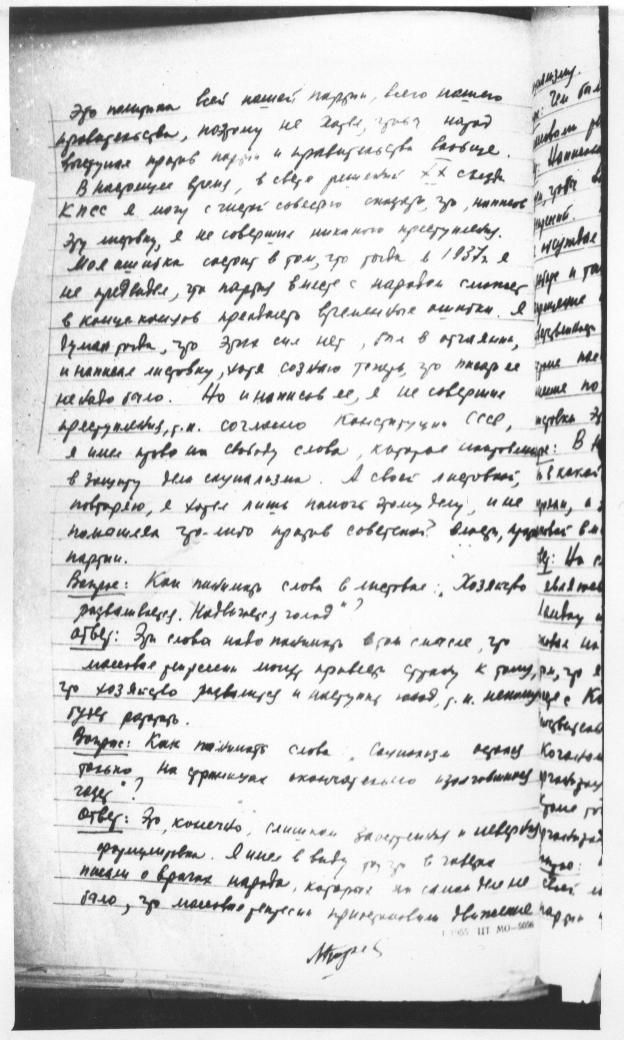
In the present case I can testify as follows:
The mass repressions of Soviet people which
were carried out in our country in 1937 and which
I considered unlawful, not corresponding to the cause
of the cause of socialism, aroused in me a feeling of pain
for the fate of the revolution in our country, a feeling of outra-
ge at these repressions. I believed in our years was
devoted to the cause of socialism and to the measure of my strength and
possibilities fought for socialism. And when I
saw that they arrest among many Soviet
people, and not only people standing in high
posts, but also simple people, I came to the conclusion
that by such a path harm is done to the revolution,
to the cause of socialism in our country, acting over lawless-
nesses. Of concrete facts of these mass
repressions at that time in Inte I knew very many,
from these after all they also talked a lot, and I myself saw it,
although no one of my relatives or close ones
was arrested then. At the same time I want to emphasize
that I did not believe in the rightness, in the justification
of these repressions, since I could not know for sure, whet-
her really, whether really they arrest this or that
person, but I considered that such mass
repressions are justified by nothing, they will not be so,
moreover as I considered, they only harm the cause
of our country.
And so as a result of my feelings, as a result
of this [illegible] and of talks [illegible] of mass
repressions I wrote in 1937 that ill-fated
leaflet for which I was tried in 1939.
The writing of this leaflet is connected with a certain Kogan
Korets
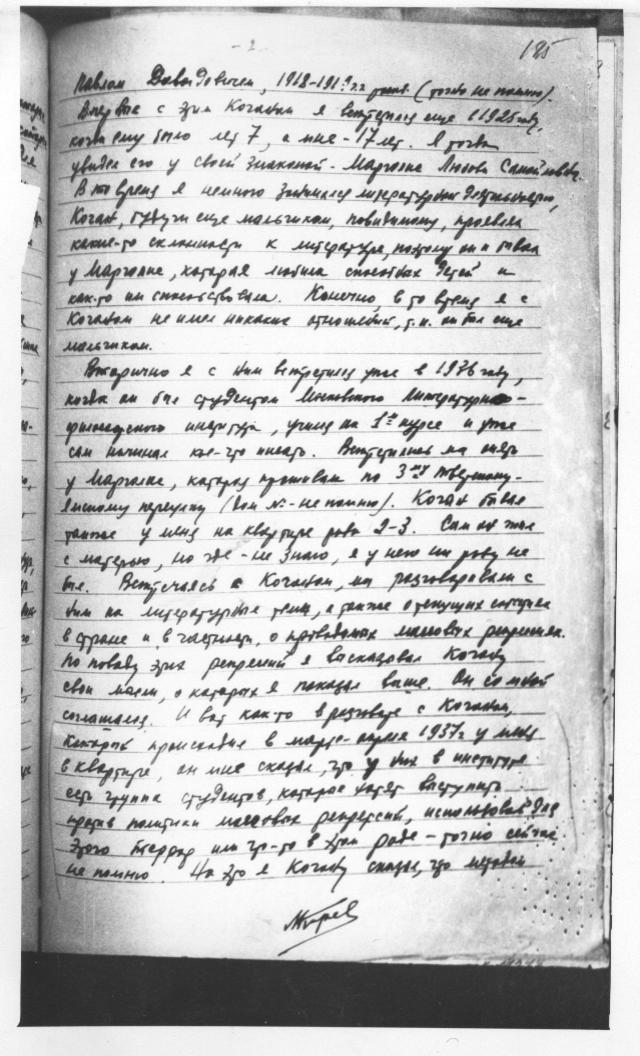
- 2 -
[in the margin] 185
Pavel Davydovich, 1918-1942 (killed in the war).
For the first time I met this Kogan back in 1935,
when he was about 17, and I - 27 years. I simply
saw him at an acquaintance of mine - Margalita Lvovna Saminskaya.
At that time I was somewhat engaged in literary activity,
Kogan, being still a boy, a novice, was trying
in some way toward literature, therefore we with him
at Margalita's, who liked to gather people and
somehow to introduce them. Of course at that time I
had no relations with Kogan, since he was still
a boy.
A second time I met him already in 1936,
when he was a student of the Literary Institute -
[illegible] institute, was in his 1st year and already
himself was beginning to write some thing. We met again
at Margalita's, who lived on 3rd [illegible]
[illegible] (house No. I do not remember). Kogan then
studied at our apartment some 2-3 times. He himself also
with [illegible], but where - I do not know, and at his place we also did not
go. Meeting with Kogan, we talked with
him on literary subjects, about various current events
in the country and in particular about the mass repressions being carried out.
Concerning these repressions I expressed to Kogan
my thoughts, about which I testified above. He
agreed with me. And once in a conversation with Kogan
which took place in March-April 1937 at my
apartment, he told me that at their institute
there is a group of students which is also outraged
by these mass repressions, [illegible]
of this terror or something of that sort - exactly now
I do not remember. To this I said to Kogan that [illegible]
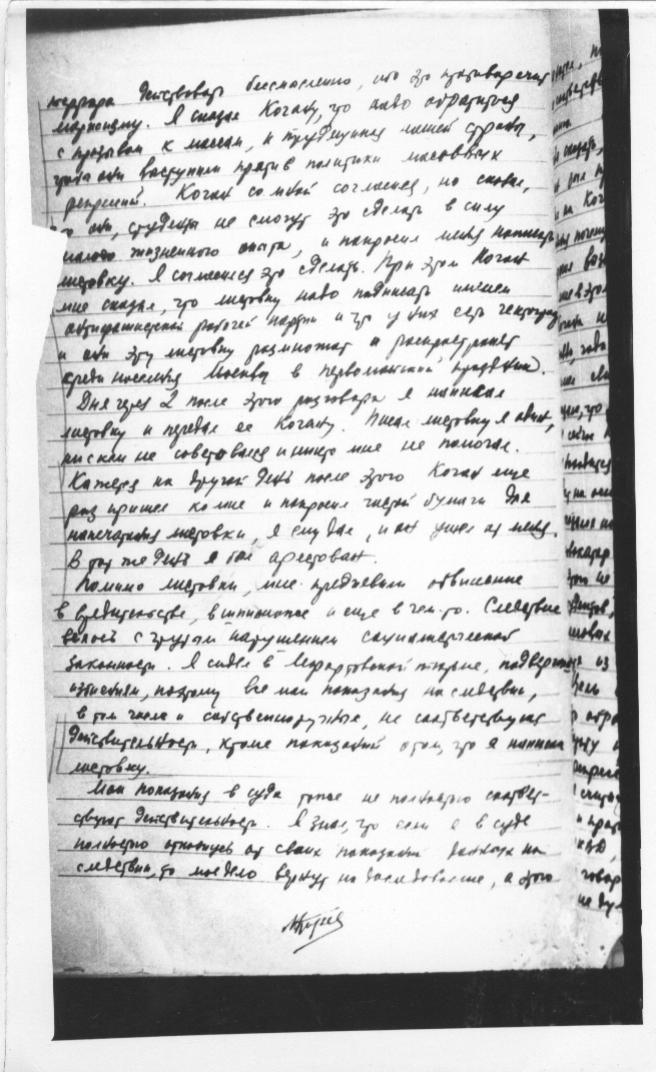
Korets
[illegible] certainly, that this [illegible]
is wrong. I told Kogan that one must turn
with a protest to the masses, to the working people of our country,
so that they would outrage the ruling [illegible] of the mass
repressions. Kogan agreed with me, but said
that they, the students, would not be able to do this by reason
of their small experience, and asked me to write
a leaflet. I agreed to do this. At the same time Kogan
told me that the leaflet must be written in the name
of an abstract worker of the party and that they have a resolution
and they will make copies of this leaflet and distribute it
among the population of Moscow in underground print shops.
Some 2 days after this conversation I wrote
the leaflet and handed it to Kogan. I wrote the leaflet alone,
consulted no one and no one helped me.
It seems the next day after this Kogan once
more came to me and asked for the text [illegible] for
the printing of the leaflet, I gave it to him, and then already on it,
that same day I was arrested.
Besides the leaflet, they brought a charge against me
of wrecking, a fabricated one and also of the fact that. The investigation
was conducted with the aim of violating socialist
legality. I sat in Lefortovo prison, was subjected to bea
tings, because they showed me at the investigation,
including also the investigator [illegible], not testifying
[illegible], except testimony that I wrote
the leaflet.
My testimony in court also does not fully corres-
pond to reality. I knew that if I in court
fully renounce my testimony given at the
investigation, then this will be to my benefit, but this
Korets
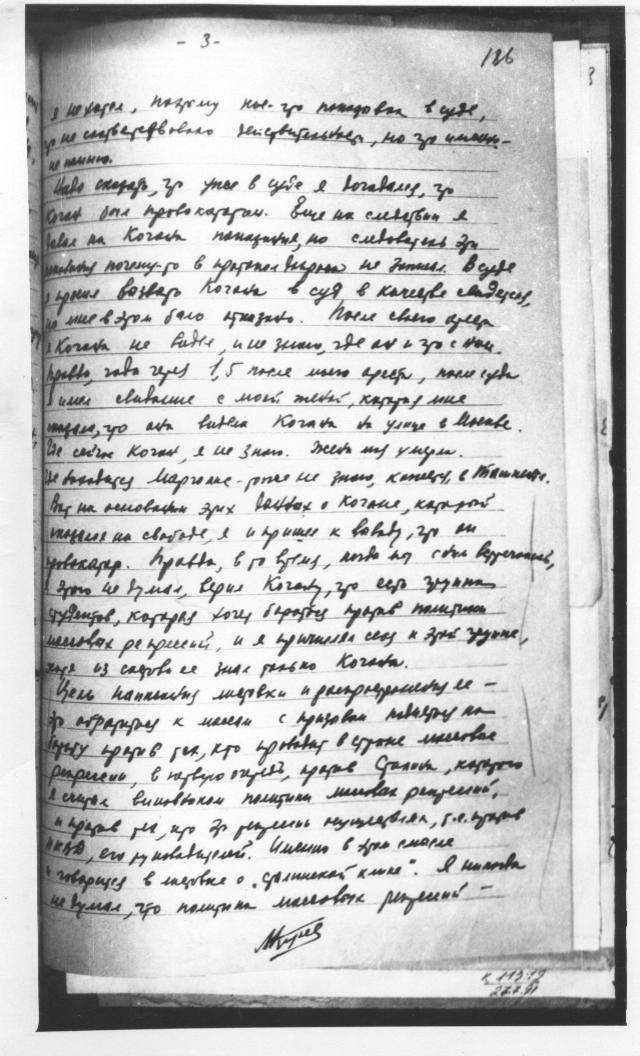
- 3 -
[in the margin] 186
I did not want to, because I somehow hoped in court
that it does not correspond to reality, but this [illegible]
I do not remember.
It must be said that already in court I admitted that
Kogan was a provocateur. Already at the investigation I
gave testimony against Kogan, but the investigator this
[illegible] for some reason did not enter in the interrogation record. The question
of summoning Kogan to court as a witness,
to me in that the matter was refused. After this trial
I did not see Kogan and do not know where he is and what is with him.
There passed years about 15 after my arrest, when already
I was living [illegible] with my wife, who
told me that she had seen Kogan on a street in Moscow.
Where Kogan is now, I do not know. Here is my [illegible].
From the accounts of Margalita - I also do not know, who with [illegible].
Further on the basis of these talks about Kogan, who
[illegible] at the investigation and I came to the conclusion that he
is a provocateur. Besides, at that time, when we ourselves were outraged
by this did not think, besides Kogan, that his [illegible]
[illegible], who although to fight against the mass
[illegible] repressions, and I came self and this [illegible],
through [illegible] he knew only Kogan.
The aim of writing the leaflet and of distributing it -
is to turn to the masses with a call of protest concerning
the terror of those who fought in the country of mass
repressions, in the first place, against Stalin, whom
I considered the one to blame for the mass repressions,
and against those who carried out these repressions, i.e. against
the NKVD, its leaders. It is precisely in this sense
that I repeat myself in the leaflet about the "Stalin clique". I never
thought that the policy of mass repressions -
Korets
This violates our whole people, our whole
government, therefore will not give, [illegible] the people
[illegible] against the party and the government in general.
At the present time, in the light of the decisions of the XX Congress
of the CPSU I can say with a clear conscience that, having written
this leaflet, I committed no crime.
My error consists in that then in 1937 I
did not foresee that the people together with the party would sweep away
in the end the temporarily temporary [illegible] I
thought then that this was not yet, as in an organization,
and wrote the leaflet, although I realize now that then to
write it was. But even having written it I did not commit
a crime, since according to the Constitution of the USSR
I had the right to freedom of speech, which consists in: In
in defense of the cause of socialism. In my leaflet, in what
[illegible], I wanted only to help this cause, and did not think, but
was inflicting anything against Soviet power, against [illegible]
the party.
Question: How do you understand the words in the leaflet: "The economy of the country
is falling apart. Famine is approaching"?
Answer: These words must be understood in the sense that
mass repressions can bring the country to the point that
that the economy will fall apart and famine will come, since [illegible]
[illegible] the people.
Question: How do you understand the words "The Stalin [illegible] of Kogan
[illegible] on the principles of economic [illegible]
[illegible]"?
Answer: This, of course, [illegible] [illegible] and [illegible]
[illegible]. I had in mind that in those years
[illegible] and enemies of the people, whom we ourselves [illegible]
1930, that mass repressions [illegible] [illegible] the people
Korets
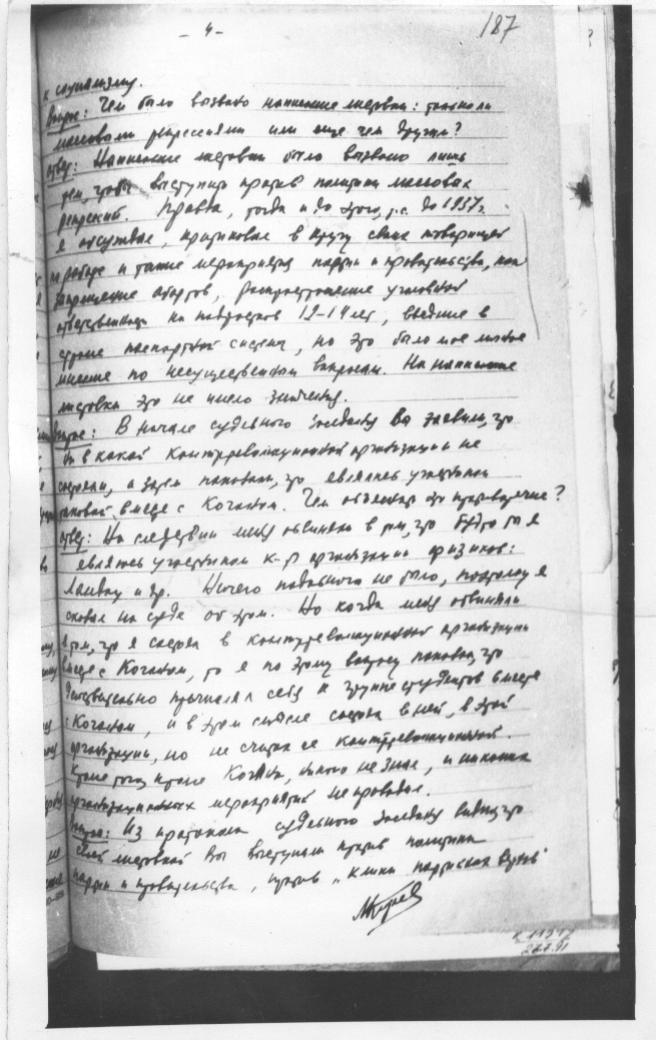
- 4 -
[in the margin] 187
and of socialism.
Question: What caused the writing of the leaflet: the facts
of the mass repressions or something else besides?
Answer: The writing of the leaflet was caused only
by this, so as to outrage the ruling [illegible] of the mass
repressions. Besides, then I in [illegible], i.e. in 1937
I condemned, carried out at that time [illegible]
[illegible] and also measures of the party and the government, such as
the permitting of abortions, [illegible] of criminal
liability for [illegible] of 12-14 years, the introduction in
the country of the passport system, but this was not the main
opinion but [illegible] a question. On the writing
of the leaflet this had no significance.
Question: At the beginning of the judicial investigation you stated that
you in any counterrevolutionary organization did not
belong, and then testified that you were a participant
[illegible] together with Kogan. How is this contradiction to be explained?
Answer: At the investigation I was told to the effect that supposedly I
am a participant in a c.-r. organization consisting of:
Landau and others. Nothing of the sort existed, therefore I
renounced this at the trial. But when they announced to me
[illegible], that I had belonged to a counterrevolutionary organization
together with Kogan, then on this question I testified that
[illegible] acknowledged myself in [illegible] together
with Kogan, and in this sense said at the trial, in this
[illegible], but did not consider it counterrevolutionary.
In addition besides Kogan, no one knew, and no
[illegible] measures did I carry out.
Question: From the record of the judicial investigation it is evident that
your leaflet was [illegible] against [illegible]
the party and the government, against "the clique of [illegible] Bukharin"
Korets
How is this to be understood?
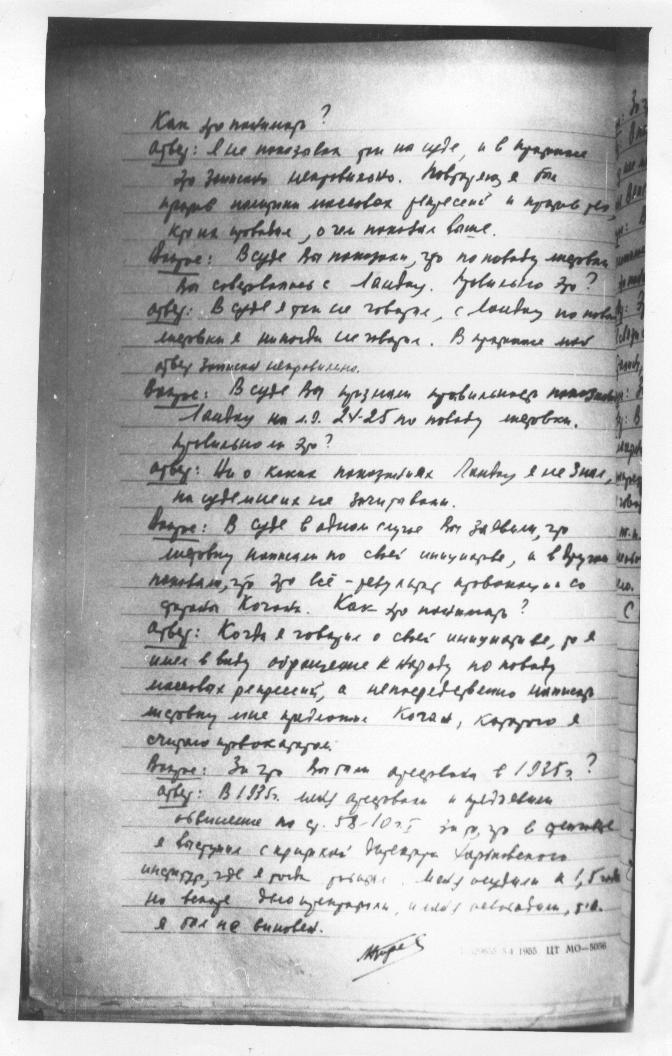
Answer: I did not appeal neither at the trial, but in [illegible]
this [illegible] [illegible]. I shall repeat [illegible]
against [illegible] mass repressions and against those
who carried them out, as I testified above.
Question: In court you testified that concerning the leaflet
you consulted with Landau. [illegible] this?
Answer: In court I did not say this, with Landau concerning
the leaflet I never spoke. In [illegible] to me
[illegible]
Answer: [illegible]
Question: In court you, being [illegible], testified:
Landau on ld. 24-25 concerning the leaflet.
[illegible] this?
Answer: I knew of no testimony of Landau,
at the investigation did not interrogate.
Question: In court in one case you stated that
you wrote the leaflet on your own initiative, and in another
testified that this [illegible] organization with
[illegible] of Kogan. How is this to be understood?
Answer: When I spoke of my initiative, I
had in mind the content and the text, but the occasion
of the mass repressions, while the immediate [illegible]
of the leaflet was proposed to me by Kogan, whom I
considered a provocateur.
Question: For what were you arrested in 1935?
Answer: In 1935 I was arrested and there was brought
a charge under Art. 58-10 [illegible] in that in [illegible]
I [illegible] [illegible] [illegible] [illegible]
of the institute where I then worked. [illegible] [illegible] in the city of [illegible]
on [illegible] [illegible], and was released, since
I cases not [illegible].
Korets
The text is taken from photographs of the case file. Words that could not be made out are marked [illegible]. Where a page is too faint, only the photograph has been left.