A reading of the photograph, uncertain in places. Check it against the photograph.
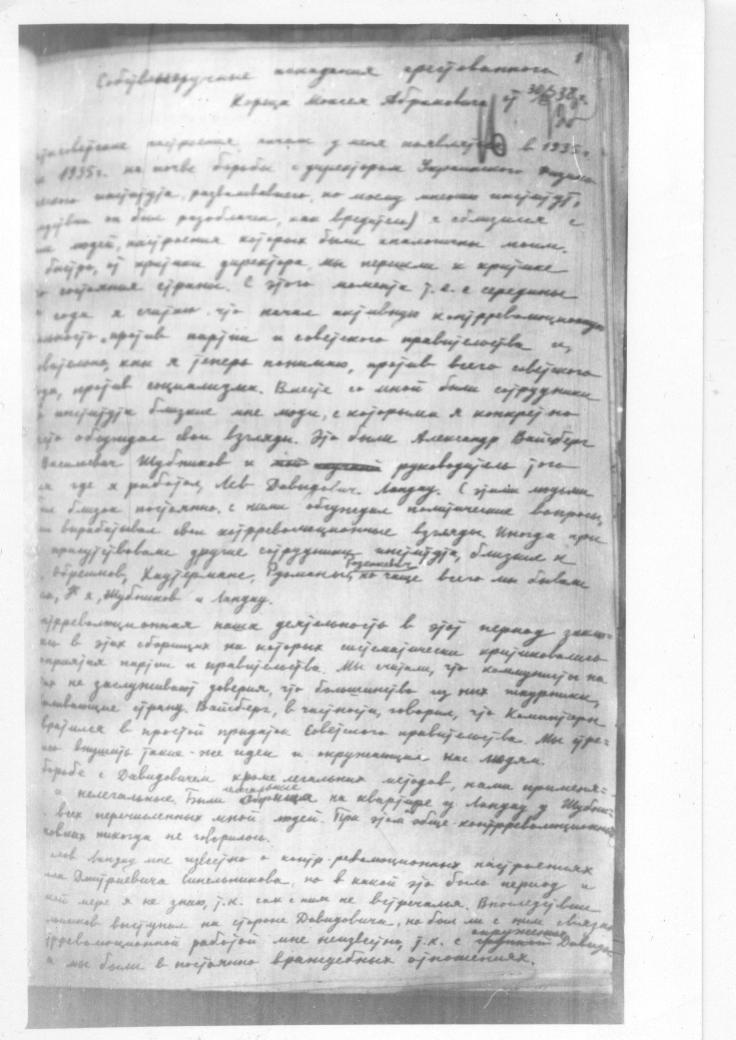
Testimony in his own hand of the arrested man
Moisey Abramovich Korets
[illegible]
a counterrevolutionary group, which arose among us in 1935
in 1935 on the basis of a struggle with the leadership of Khimmash [illegible]
of our institute, was being worked out, concerning our institute,
[illegible] into two groupings, us [illegible] and [illegible] with
their people, whose attitudes were similar to ours.
Quickly, from criticism of the director, we passed to criticism
and of the Soviet country. From that moment [illegible] the middle
of the year I consider that our active counterrevolutionary
[illegible] against the Party and the Soviet government and,
[illegible], as I now understand, against the whole Soviet
[illegible], against socialism. Together with me were staff
of the institute, people close to me, with whom I repeatedly
[illegible] discussed my views. These were Aleksandr Vaisberg
[illegible] Shubnikov and [illegible] leading persons
[illegible] Lev Davidovich Landau. (With these people
we quickly became acquainted, with us they discussed political questions,
and worked out their counterrevolutionary views. Sometimes pre-
sent were other staff of the institute, close to
[illegible], Kaufman, Rumer, [illegible] also was at the meetings
of them, I, Shubnikov and Landau.
[illegible] our activity in this period consisted
in these meetings at which critical
remarks of the Party and the government were expressed. We considered that communism not
[illegible], that the majority of us working people,
[illegible] the country. Vaisberg, in particular, said that communism
comes down to a simple sale of the Soviet government. We [illegible]
not [illegible] ideas and the people around us.
The struggle with Davidovich besides [illegible], by us were organized
illegal ones as well. There were meetings at Landau’s apartment at Shubnikov’s
of all the people I listed. About these general counterrevolutionary
meetings nothing was ever said.
[illegible] Landau I know of the counter-revolutionary attitudes
[illegible], but in what period this was and
[illegible] I do not know, since I myself did not meet with him. Later
[illegible] on Davidovich’s side, but whether he was connected with him
[illegible] by work is unknown to me, since with [illegible] Davidovich
and we were on inimically hostile terms.
P. 123 Interrogation of 04.05.38 p.124 p.125 p.126 p.126a
A reading of the photograph, uncertain in places. Check it against the photograph.
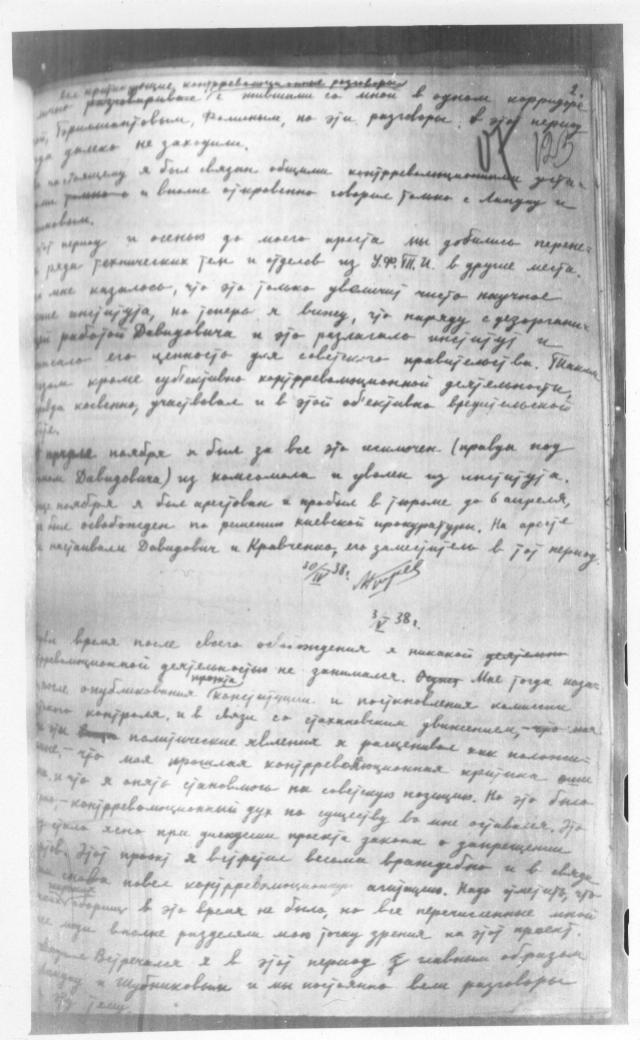
[illegible] of counterrevolutionary conversations
personally talked and met with me in one corridor
[illegible], Flippe, but these conversations in this period
of the year did not go far at all.
[illegible] I was bound by common counterrevolutionary views
[illegible] at a higher definite meeting also with Landau and
[illegible].
[illegible] period and in the autumn before my arrest we achieved the transfer
of a number of technical themes and departments from U.F.T.I. to other places.
[illegible] it seemed to me that this would only increase the number of scientific
[illegible] of the institute, but now I see that along with [illegible]
[illegible] the work of Davidovich and this was demoralizing the institute and
[illegible] its value for the Soviet government. Thus
[illegible] besides subjectively counterrevolutionary activity,
[illegible] indirectly, took part also in this objectively harmful [illegible]
[illegible].
In April November I was for all this expelled (true, under
[illegible] of Davidovich) from the Komsomol and dismissed from the institute,
[illegible] of November I was arrested and remained in prison until 6 April,
and was released by a decision of the Kiev prosecutor’s office. At the arrest
[illegible] named Davidovich and Kravchenko, but a deputy in that period.
10/IV 38. Korin
3/V 38.
[illegible] time after my release I did not engage in any [illegible]
[illegible] activity. However it seemed to me then
[illegible] published [illegible] and lectured [illegible]
[illegible] of control, and in connection with [illegible] the dismissal, that we
[illegible] political phenomena I assessed as [illegible]
[illegible], that my past counterrevolutionary criticism [illegible]
[illegible], that I am again taking up a Soviet position. But this was
[illegible] the counterrevolutionary spirit in essence remained in me. This
[illegible] clear at the report of a draft of data about [illegible]
[illegible] this draft I met very hostilely and in connection
[illegible] a new counterrevolutionary agitation. It must be said that
[illegible] at that time there was not, but all those listed by me
[illegible] fully shared my point of view on this draft.
[illegible] I met in this period with [illegible] manner
[illegible] and Shubnikov and we constantly held conversations
A reading of the photograph, uncertain in places. Check it against the photograph.
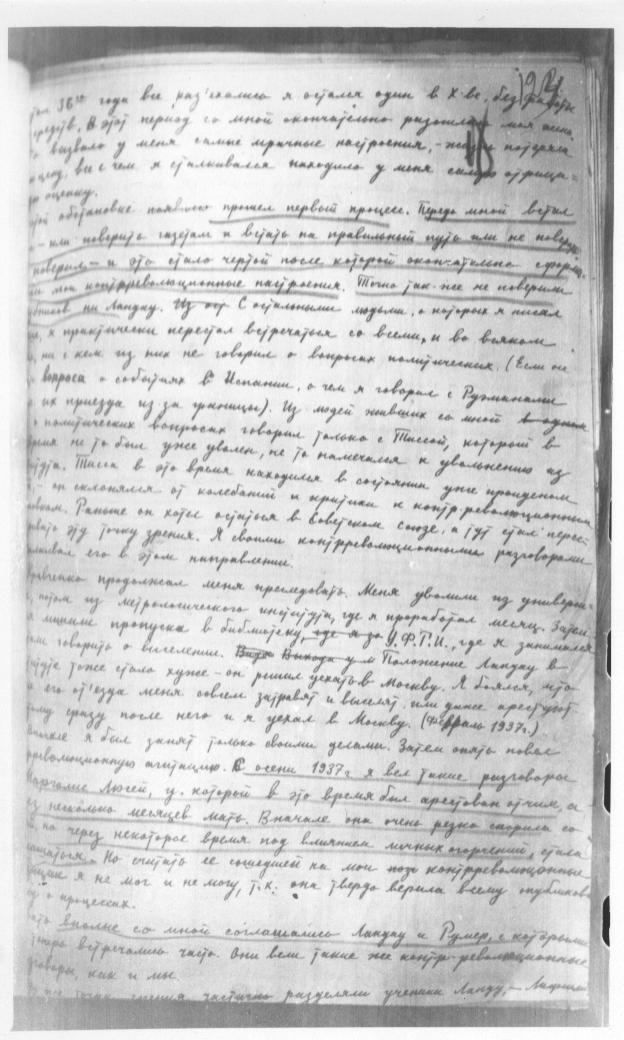
[illegible] of the year ’36 everyone left and I remained alone in Kh.ve. [illegible]
[illegible]. In this period with me finally [illegible]
[illegible] called up in me the gloomiest attitudes, [illegible]
[illegible], everyone I came across found in me [illegible]
[illegible] despair.
[illegible] Abramovsky at last the first trial passed. Before me stood
[illegible] I will not believe people and I believe onto the right path we not [illegible]
[illegible] and this became a line after which [illegible]
[illegible] my counterrevolutionary attitudes. In just the same way did not believe
[illegible] nor Landau. [illegible] With the other people, about whom I wrote
[illegible], I practically stopped meeting with everyone, and in any
[illegible] with none of them did I speak of political questions. (If not
[illegible] of the question of events in Spain, of which I spoke with Rumerman
[illegible] of arrival from abroad). Of the people who lived with me [illegible]
[illegible] of political questions I spoke only with Tallya, who in
[illegible] either had already been dismissed, or was slated for dismissal from
[illegible]. Tallya at this time was in a state [illegible]
[illegible] from vacillations and criticism to counterrevolutionary
[illegible]. Earlier he here and there dared in the Soviet Union, and [illegible] already trans-
[illegible] this point of view. I with my counterrevolutionary conversations
[illegible] him in this direction.
[illegible] continued to persecute me. I was dismissed from the univer-
[illegible] from the metrological institute, where I worked for a month. Then
[illegible] a pass to the library, where I [illegible] U.F.T.I., where I was engaged
[illegible] I am speaking about the gallows. [illegible] Landau’s position in-
[illegible] also became worse — he decided to leave for Moscow. I was afraid that
[illegible] from here they would tear me to pieces completely and [illegible], or even arrest
[illegible] right after him and I left for Moscow. (February 1937)
[illegible] I was busy only with my own affairs. Then again a new
[illegible] agitation. In the autumn of 1937 I held such conversations with
[illegible] of people, at whose the husband had been arrested at that time, and
[illegible] several months ago. At first she very rarely came round with
[illegible], but before some time, under the influence of personal shocks, became
[illegible]. But I look at her following one at my my counterrevolutionary
[illegible] I could not and cannot, since she firmly believed everything publicly
[illegible] and the trials.
[illegible] Landau and Rumer, with whom
[illegible] also met, fully agreed with me. They held the same counter-revolutionary
conversations as we did.
[illegible] partly shared Landau’s convictions, [illegible]
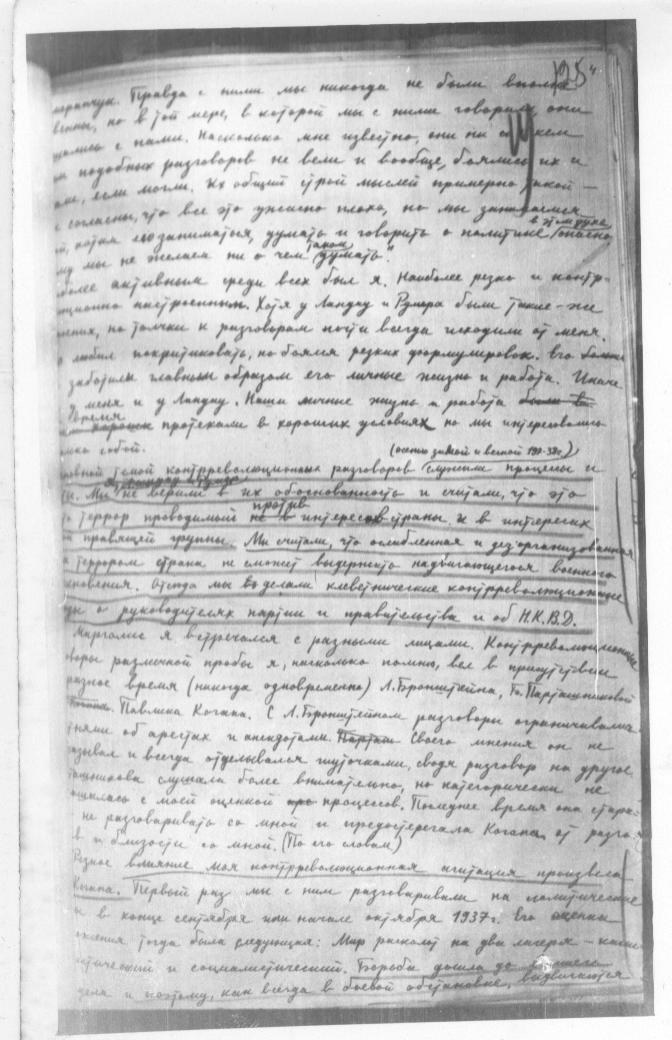
A reading of the photograph, uncertain in places. Check it against the photograph.
[illegible]. True, with them we never were [illegible]
[illegible], but to the extent to which we spoke with them they
[illegible] with us. As far as I know, they did not [illegible]
[illegible] did not hold such conversations and in general, further than them and
[illegible], if one can. Their general cast of mind is roughly this —
[illegible] agree that all this is terribly bad, but we [illegible]
[illegible], at times falling into thought, think and speak of [illegible]
[illegible] did not write me about anything [illegible].
[illegible] the active one among all was I. Most sharply and counter-
[illegible] attitudes. Although Landau and Rumer had the same
[illegible], but more rarely, and the conversations almost always came from me,
[illegible] raising his voice, but fearing sharp formulations. This was
[illegible] chiefly his personal food and work. [illegible]
with me and with Landau. Our personal food and work [illegible]
[illegible] however passed in good conditions but we [illegible]
[illegible] one’s own.
(very sharply and in the spring of 1937-38)
[illegible] the theme of the counterrevolutionary conversations [illegible] were also
[illegible]. We did not believe in their being well-founded and considered that this
[illegible] terror being carried out [illegible] against [illegible] of the country and in the interests
[illegible] of the ruling group. We considered that the weakening and disorganization
[illegible] by terror of the country has no [illegible] of approaching military
[illegible]. From this we drew inevitable counterrevolutionary
[illegible] about the leaders of the Party and the government and about the N.K.V.D.
In parallel I met with various persons. Counterrevolutionary
[illegible] of various grade I, as far as I remember, conducted in the presence
at different times (never at the same time) of A. Bronshtein, B. [illegible]
[illegible] Pavlik Kogan. With A. Bronshtein the conversations were limited
[illegible] about arrests and by anecdotes. [illegible] his opinion he did not
[illegible] and always got off with little jokes, turning the conversation onto something else
[illegible] listened more attentively, but categorically did not
[illegible] with my assessment about of the trials. Lately she [illegible]
did not talk with me and warned Kogan against razgo-
[illegible] and [illegible] with me. (By his words)
[illegible] influence my counterrevolutionary agitation produced
[illegible]. The first time he and I talked on [illegible]
and at the end of September or the beginning of October 1937. His [illegible]
[illegible] then was the following: The world is split into two camps — capi-
talist and socialist. The struggle must [illegible]
[illegible] and therefore, as always in a battle situation, [illegible]
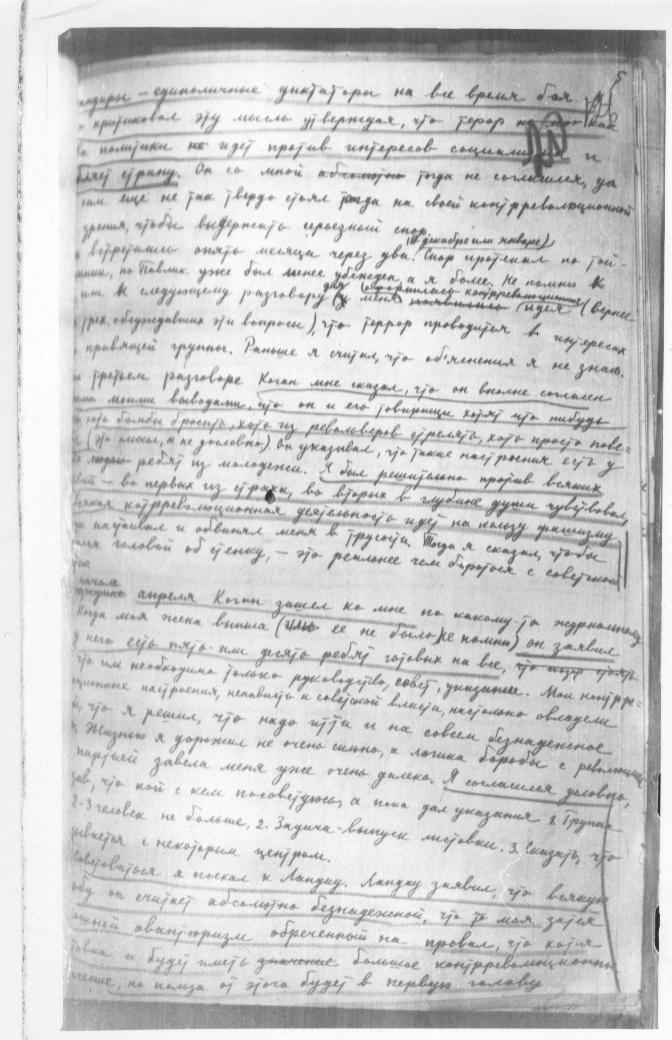
A reading of the photograph, uncertain in places. Check it against the photograph.
[illegible] — one-man dictators for the whole time of the battle. [illegible]
[illegible] was drilling this thought, asserting that terror [illegible]
[illegible] inflicts does not go against the interests of socialism and
[illegible] the country. He absolutely did not agree with me then, and
[illegible] did not yet stand so firmly then on his counterrevolutionary
[illegible], as to withstand a serious argument.
and returned again in about two months. (December or January)
[illegible], but Pavlik was already less convinced, and I more. To our [illegible]
[illegible] to the next conversation [illegible] (a contemporary counterrevolutionary
[illegible], who had discussed these questions), that the terror was carried out in the interests
of the ruling group. Earlier I considered that an explanation I do not know.
[illegible] conversation Kogan told me that he fully agrees
[illegible] with the opinion [illegible], that he and his comrades at least something
[illegible] must throw, though shoot from revolvers, though simply hang-
[illegible] (this is unclear, not word for word). He indicated that such a mood exists among
[illegible] of youth from the youth. I was decisively against any
[illegible] — first from fear, second in the depth of my soul I felt,
[illegible] counterrevolutionary activity goes to the benefit of fascism,
[illegible] scientific and ordinary me in [illegible]. Then I said, that
[illegible] a head one about success, — this will be decided by that struggle with the Soviet
[illegible]
[illegible] of April Kogan stopped by me on some [illegible]
[illegible] me very [illegible] ([illegible] I no more do not remember it) he declared
he has five or ten fellows ready for anything, that [illegible]
that all they need is only leadership, advice, a direction. We counterre-
volutionary attitudes, hatred of the Soviet power, it is necessary to unite
and that I decided that one must go even onto the completely hopeless.
[illegible] I valued not very strongly, and the logic of the struggle with [illegible]
[illegible] had already led me very far. I agreed in a businesslike way,
[illegible], that my I will consult with someone, and for now gave an instruction 1. A group
of 2-3 persons no more, 2. The task — issues of leaflets. 3. To watch, what
[illegible] with certain centers.
[illegible] I went to Landau. Landau declared that [illegible]
[illegible] he considers absolutely hopeless, that [illegible] my [illegible]
[illegible] adventurism doomed to failure, that [illegible]
[illegible] and will be little [illegible] A big counterrevolutionary
[illegible], on the shoulders from this will be first of all
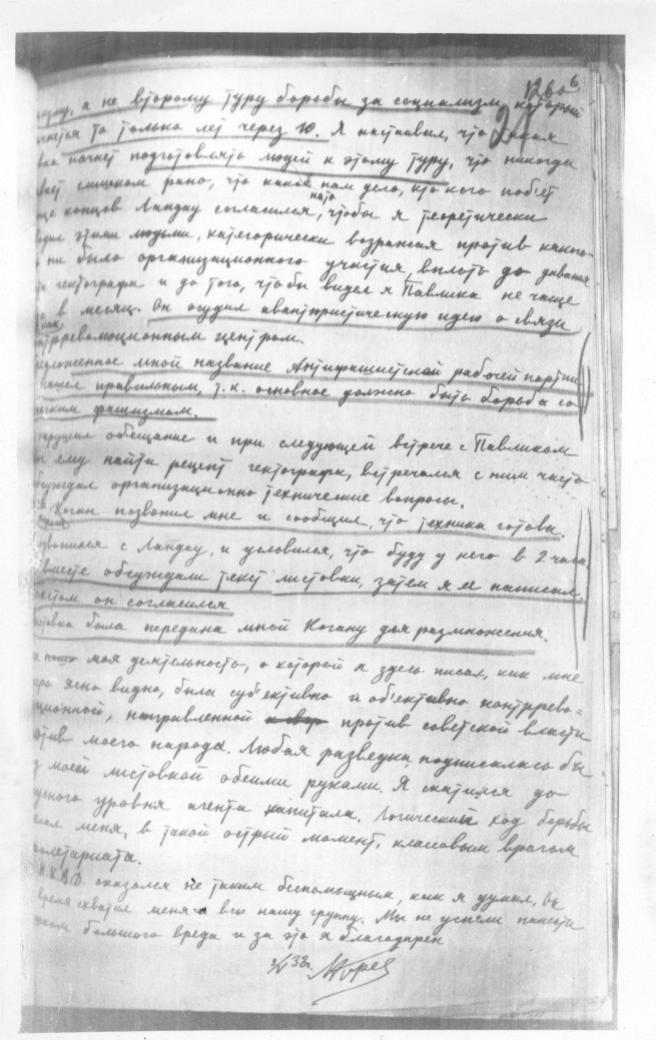
A reading of the photograph, uncertain in places. Check it against the photograph.
[illegible], and not [illegible] a round of the struggle for socialism [illegible]
[illegible] that one only mine through 10. I insisted that [illegible]
[illegible] will begin to prepare people for this round, that never
[illegible] too early, that in no way our affair, that someone
[illegible] ends Landau agreed that I theoretically
[illegible] these people, categorically objecting to any-
[illegible] was organizational participation, up to the giving
[illegible] of leaflets and up to seeing Pavlik too no more often
[illegible] of a month. He condemned the adventurist idea of [illegible]
a counterrevolutionary center.
[illegible] by me the name of the Antifascist Workers’ Party
[illegible] correct, since the main thing must be a struggle with
[illegible] fascism.
[illegible] a promise and at the next meeting with Pavlik
I will find him a reviewer of leaflets, I met with him when
[illegible] organizational technical questions.
[illegible] Kogan telephoned me and reported that the technique is ready.
[illegible] with Landau, and agreed that I would be at his place at 2 o’clock
[illegible] discussed the text of the leaflets, then I wrote it
[illegible] he agreed
[illegible] was handed by me to Kogan for duplication.
and of this my activity, of which I wrote here, as to me
[illegible] is clearly visible, was subjectively and objectively counterrevolu-
tionary, directed [illegible] against the Soviet power
[illegible] of my people. Any intelligence service would have seized
[illegible] my leaflet with both hands. I slid down to-
[illegible] the level of an agent [illegible]. The logical course of the struggle
[illegible] me, at such a sharp moment, to the class enemies
[illegible].
The N.K.V.D. turned out not so helpless as I thought, during
[illegible] me and our whole group. We did not have time to inflict
[illegible] great harm and for this I am grateful
X/38. Korin
P.127 Interrogation of 12.05.38 p.128 p.129 p.130 p.131
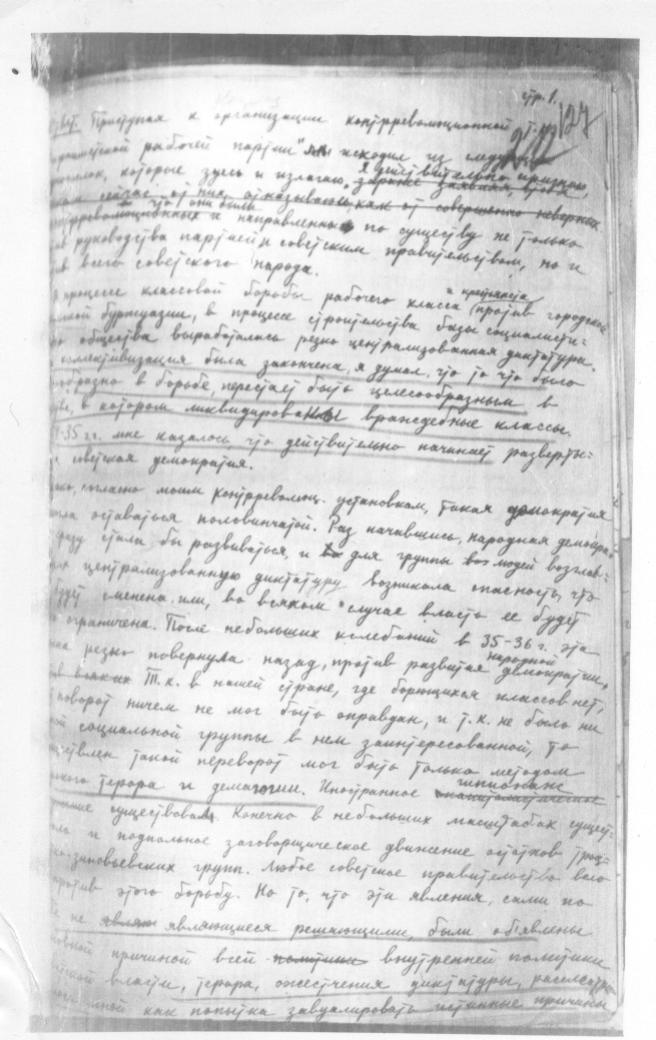
A reading of the photograph, uncertain in places. Check it against the photograph.
p. 1.
[illegible] Setting about the organization of a counterrevolutionary
[illegible] workers’ party" we proceeded from the following
[illegible], which I here set out. [illegible]
[illegible] that they were [illegible]
[illegible] and directed in essence not only
[illegible] of the leadership of the Party and by the Soviet government, but also
[illegible] of the whole Soviet people.
[illegible] in the process of the class struggle of the working class [illegible]
[illegible] of the bourgeoisie, in the process of building the base of socialism
[illegible] of society a sharply centralized dictatorship is worked out.
[illegible] was finished, I thought that [illegible] this was
[illegible] in the struggle, [illegible] will be expedient in
[illegible], in which hostile classes was being liquidated.
By ’35 it seemed to me that there really begins to unfold-
[illegible] Soviet democracy.
[illegible], however to my counterrevolutionary premises, such a democracy
[illegible] remained half-and-half. Once begun, a people’s democracy
[illegible] ought to develop, and [illegible] for a group [illegible] of people there arose
[illegible] a centralized dictatorship there arose a danger that
[illegible] will replace them, in any case its power will be
[illegible] limited. After small vacillations in 35-36 this
[illegible] turned sharply back, against developing of democracy,
[illegible] of power. Since in our country, where there are no bourgeois classes,
a turn could be justified by no one, and since there was not a single
[illegible] social group interested in it, then
[illegible] such an overturn could be only by the method
[illegible] of terror and demagogy. A foreign [illegible]
[illegible] existed. Of course on a small scale there exist-
[illegible] not an underground conspiratorial movement of individual [illegible]
[illegible] groups. Any Soviet government conducted
[illegible] this struggle. But that these phenomena, if by-
[illegible] are not decisive, were declared
[illegible] the cause of the whole [illegible] internal policy
[illegible] of power, of terror, of the intensification of the dictatorship, regard-
[illegible] as an attempt to veil [illegible] causes
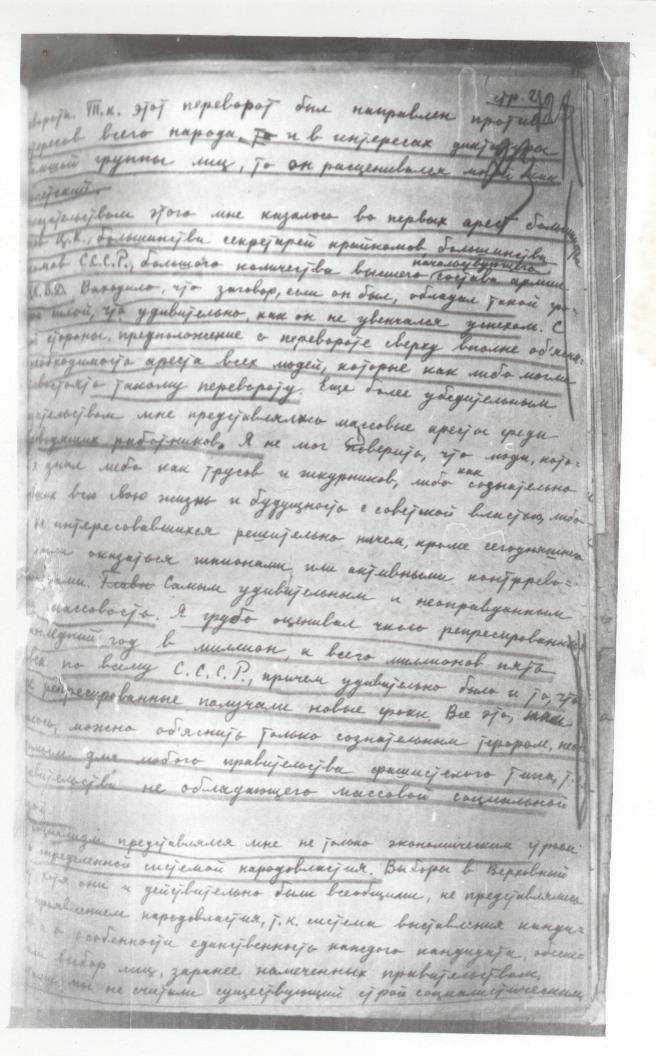
A reading of the photograph, uncertain in places. Check it against the photograph.
[illegible]. Since this overturn was directed against
[illegible] of the whole people, [illegible] and in the interests [illegible]
[illegible] of a group of persons, it was assessed by us as
[illegible]
[illegible] of this it seemed to me first the arrest [illegible]
[illegible] of the Ts.K., Blyumintseva of secretaries of Bolshevik krai committees
[illegible] of the U.S.S.R., of a large number of the higher [illegible]
N.K.V.D. It came out that the conspiracy, if there was one, possessed such [illegible]
[illegible], that it is astonishing how it was not crowned with success. From
[illegible] side, the supposition of an overturn from above [illegible] explained
[illegible] of the arrest of all people who in any way could
[illegible] such an overturn. Still more astonishing
[illegible] there seemed to me the mass arrests among
[illegible] workers. I could not believe that people, wh-
[illegible] either as cowards and self-seekers, or as consciously
[illegible] their whole life and future with the Soviet power, coul-
[illegible] interested in absolutely no one except today’s
[illegible] awaiting [illegible] or active counterrevolu-
[illegible]. Such is the most astonishing and unjustified
[illegible]. I roughly estimated the number of those repressed
[illegible] a year at a million, and in all five million
[illegible] over the whole U.S.S.R., and astonishing was also this, that
[illegible] those repressed received new lessons. All this, [illegible]
[illegible] can be explained only by conscious terror, na-
[illegible] for any government [illegible] of a type, [illegible]
[illegible] not possessing a mass [illegible]
[illegible] seemed to me not only an economic loss
[illegible] by a system of Narodniks. Elections to the Supreme
[illegible] they indeed were universal, did not seem
[illegible] of Narodniks, since the system of entering candida-
[illegible] especially of a single candidate [illegible], [illegible]
a choice of persons marked out beforehand by the government,
[illegible] did not open the existing order to socialist
A reading of the photograph, uncertain in places. Check it against the photograph.
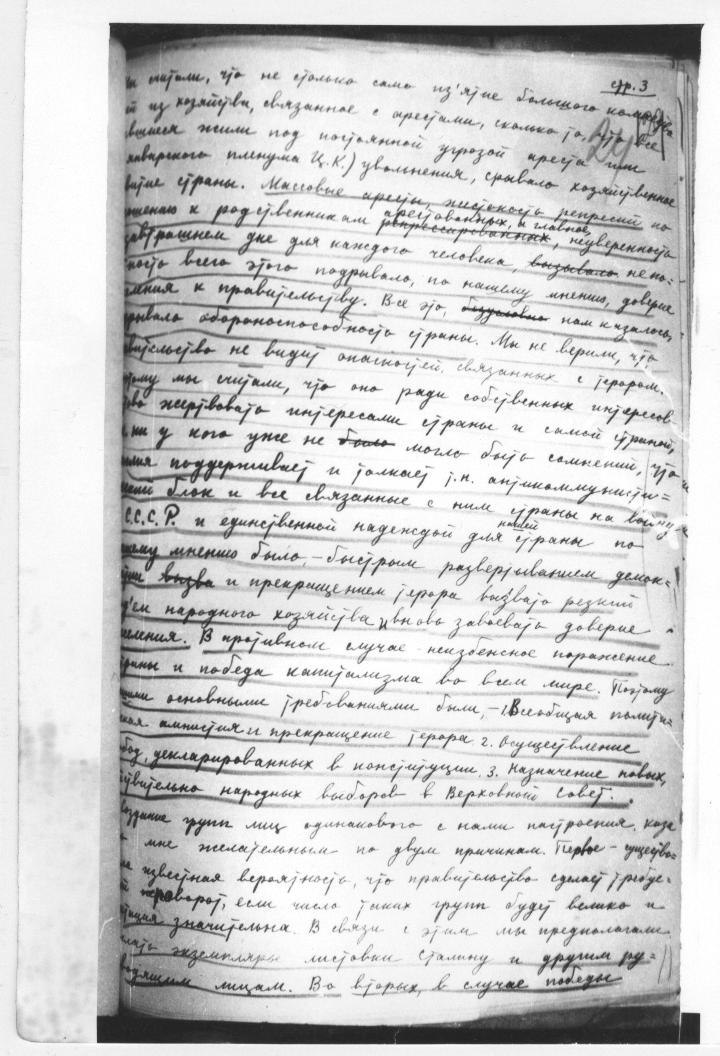
p. 3
[illegible] considered that not so much the removal itself of a large quantity
[illegible] from culture, connected with the arrests, as the fact that all
[illegible] thousands under a constant threat of arrest or
[illegible] a minute (K.K.) of dismissal, disrupted the economic
[illegible] of the country. Mass arrests, [illegible] of repressions against
[illegible] and the relatives of those arrested, and [illegible], of uncertainty
[illegible] of the day for every person, [illegible] nemo-
[illegible] of all this undermined, in our opinion, trust
[illegible] and in the government. All this, [illegible] it seemed to us,
[illegible] the defense capacity of the country. We did not believe that
[illegible] do not see the dangers connected with the terror.
[illegible] we considered that it, for the sake of its own interests,
[illegible] sacrificed the interests of the country and the strength of the country,
[illegible] for whom there already could not [illegible] be doubts that
[illegible] more suspicious and [illegible] the so-called anticommunis-
[illegible] bloc and all the countries connected with it to war
the U.S.S.R. and the only hope for the country po-
[illegible] the opinion was, — by the fastest unfolding of demo-
[illegible] of the air and the stopping of the terror caused a sharp
[illegible] of the national economy and again won the trust [illegible]
[illegible]. Otherwise an inevitable defeat
[illegible] and the victory of capitalism in the whole world. Therefore
[illegible] the basic demands were, — 1. A general politi-
[illegible] amnesty and the stopping of the terror 2. the carrying out
[illegible], declared in the constitution. 3. The setting of new,
truly popular elections to the Supreme Soviet.
[illegible] of groups of persons of the same attitude as ours, wh-
[illegible] we were lost for two reasons. First — [illegible]
[illegible] a probability that the government will manage [illegible]
an overturn, if the number of such groups will be great and
[illegible] be replaced. In connection with this we supposed
[illegible] [illegible] leaflets to Stalin and to other ru-
[illegible] persons. Secondly, in case of a victory
A reading of the photograph, uncertain in places. Check it against the photograph.
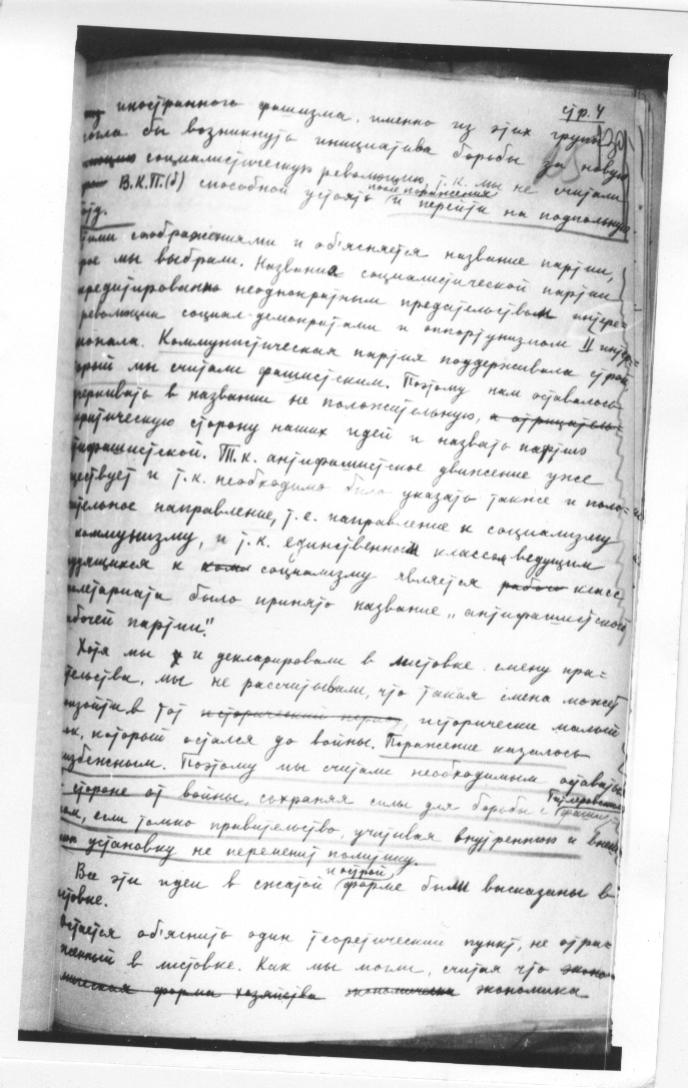
p. 4
[illegible] of foreign fascism, precisely from these groups
[illegible]. would arise an initiative of a struggle for [illegible]
[illegible] a socialist revolution since we did not consider
[illegible] the V.K.P.(b) capable of holding out [illegible] and of going over to an underground
[illegible].
[illegible] considerations also explains the name of the party,
[illegible] we chose. The names of a socialist party
[illegible] by the repeated betrayal of intere-
[illegible] by the Social Democrats and by the opportunism of the II Inter-
national. The Communist Party [illegible]
[illegible] we considered fascist. Therefore there remained to us [illegible]
[illegible] in the name not the positive, but the negative
[illegible] side of our ideas and named the party
[illegible]. Since the antifascist movement already
[illegible] and since it is necessary [illegible] to indicate also our
[illegible] direction, i.e. a direction toward socialism
[illegible], and since the only class leading
[illegible] to [illegible] socialism is the working class
[illegible] the name "antifascist
workers’ party" was adopted.
Although we [illegible] and declared in the leaflet a change of go-
vernment, we did not reckon that such a change could
[illegible] in that [illegible] historical moment
[illegible], which remained until the war. Party ones seemed
[illegible]. Therefore we considered it necessary [illegible]
[illegible] from the war, preserving forces for a struggle [illegible]
[illegible], if only the government, having strengthened the internal and exter-
[illegible] line does not change policy.
All these ideas in an old [illegible] form were expressed in
[illegible].
[illegible] I will explain one theoretical point, not reflec-
[illegible] in the leaflet. How could we, considering that [illegible]
[illegible] a form of economy [illegible]
A reading of the photograph, uncertain in places. Check it against the photograph.
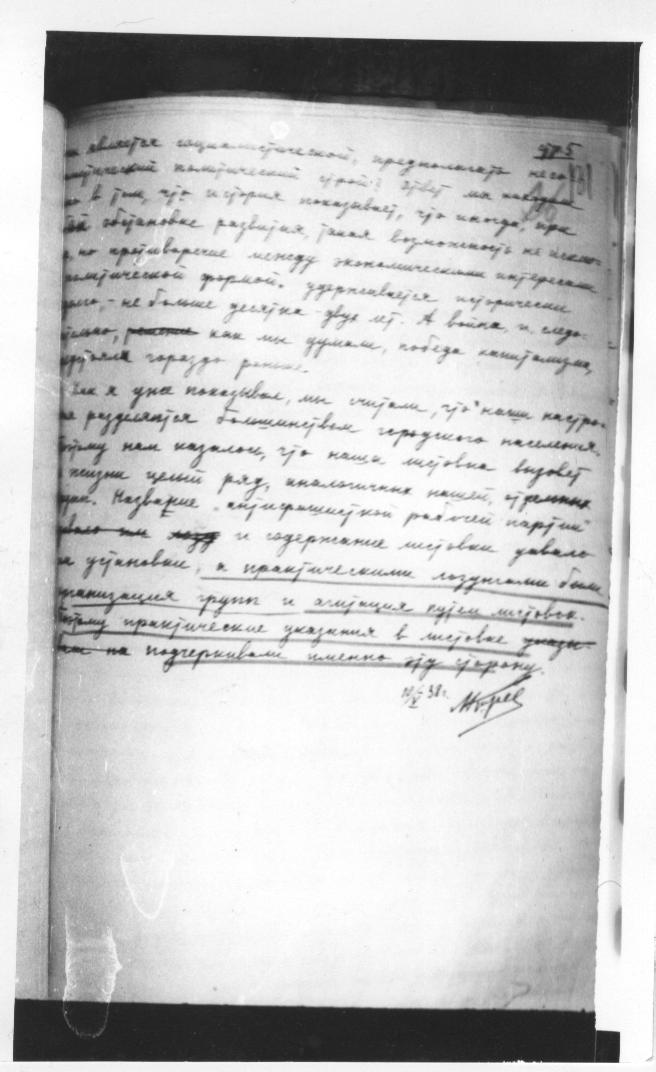
p. 5
[illegible] socialist, [illegible]
[illegible] of a capitalist country: [illegible] on [illegible]
[illegible] already, that [illegible] [illegible], that [illegible], [illegible]
[illegible] an explanation of a separation, such [illegible], [illegible]
[illegible] a contradiction between economic interests
[illegible] a form. [illegible] of interests
[illegible], — no more [illegible] where there is not. And war, and [illegible]
[illegible], [illegible] as we thought, a victory of capitalism
[illegible] much [illegible].
[illegible] I already [illegible], we consider that our [illegible]
[illegible] the bourgeoisie of the Bolsheviks [illegible] of the population,
[illegible] it seemed to us that our leaflet would call forth
[illegible] a whole series, analogous to ours, [illegible]
[illegible]. The name "antifascist workers’ party"
[illegible] and the content of the leaflets gave
[illegible] lines, and practically [illegible] was
[illegible] of groups and agitation by means of leaflets.
[illegible] practically indicated in the leaflet [illegible]
[illegible] supported precisely this side.
17/V 38. Korin
P.132 Interrogation of 22.05.38 p.133 p.134
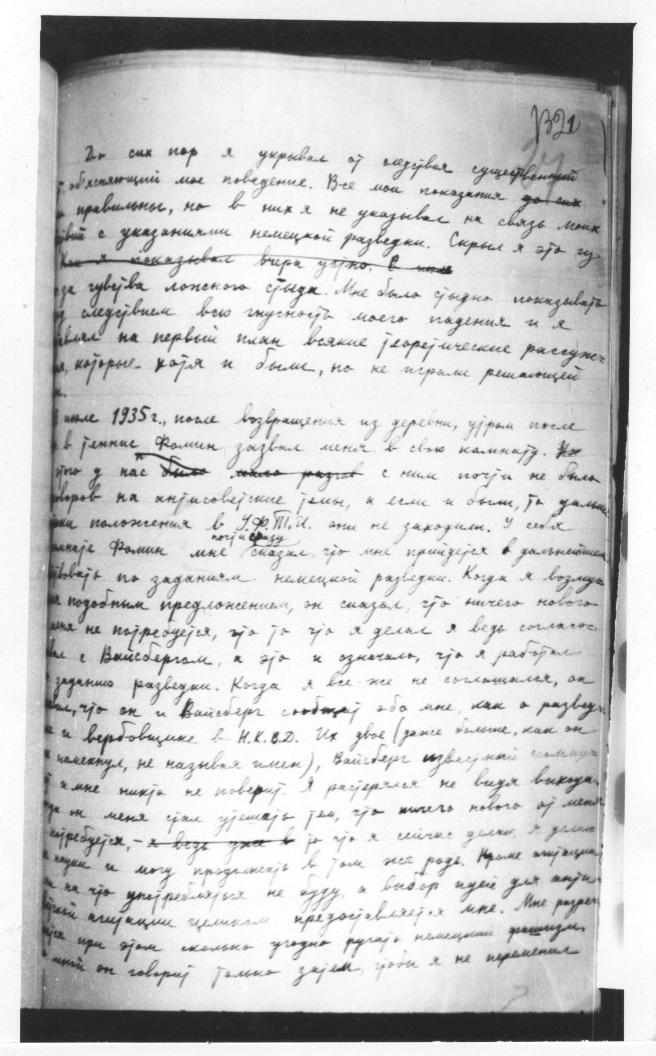
A reading of the photograph, uncertain in places. Check it against the photograph.
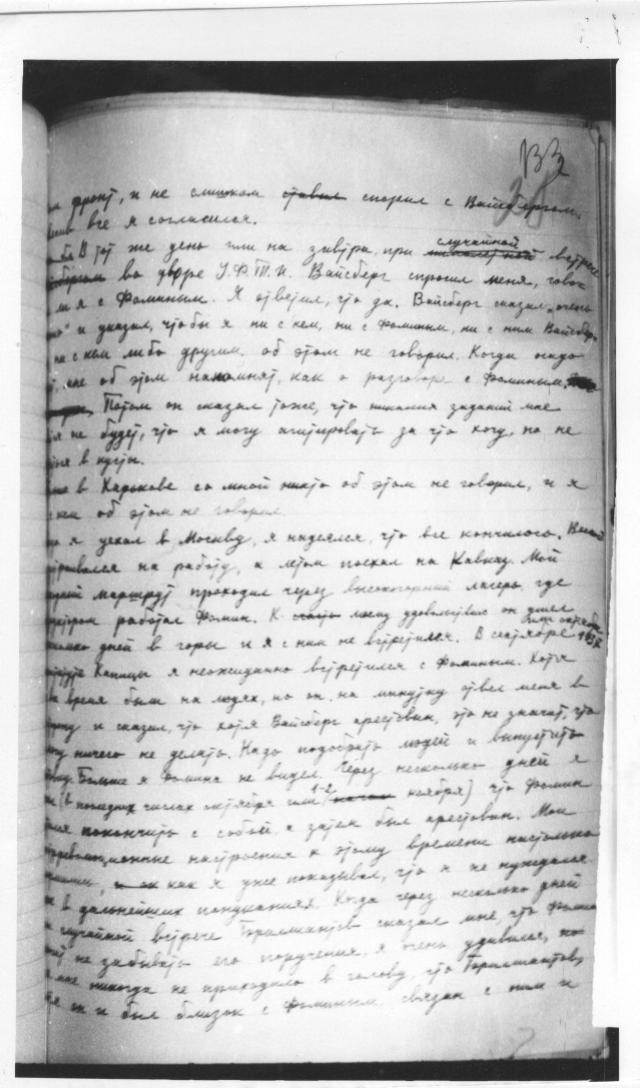
Up to now I have concealed from the investigation an essential
[illegible] my conduct. All my testimony is given
correctly, but in it I did not point to my connection
[illegible] with assignments of German intelligence. I concealed this from
[illegible] a feeling [illegible]. In [illegible]
[illegible] a feeling of false shame. I was ashamed [illegible]
[illegible] the investigation the whole vileness of my fall and I
[illegible] at the very first any theoretical reasonings
[illegible], although they were, but did not play a decisive
[illegible]
[illegible] 1935, after returning from the village, [illegible] after
[illegible] Fomin called me into his room. [illegible]
that with us [illegible] a conversation with him almost did not [illegible]
[illegible] on anti-Soviet themes, I if there was, then further
[illegible] attitudes at U.F.T.I. they did not go. At his place
[illegible] Fomin [illegible] told me that I would have in future
[illegible] on assignments of German intelligence. When I [illegible]
[illegible] by such a proposal, he said that nothing new
[illegible] would not be required, that what I was doing I would be in agreement
[illegible] with Vaisberg, and this meant that I work
[illegible] of intelligence. When I nevertheless did not agree, he
[illegible], that he and Vaisberg will break about me, as about an intel-
[illegible] and a recruiter to the N.K.V.D. The two of them (mark, how he
[illegible], without naming names), Vaisberg [illegible]
[illegible] no one will believe. I of course saw no way out
[illegible] from me [illegible] already, that nothing new from me
[illegible], — [illegible] what I am doing now, I do
[illegible] and can be of use [illegible] ever more rarely. Besides [illegible]
[illegible] that [illegible] I am not going, but quickly ideas for anti-
[illegible] agitation [illegible] [illegible] to me. To me [illegible]
[illegible] this as much as one likes [illegible] [illegible]
[illegible] he said such [illegible] that I not [illegible]
A reading of the photograph, uncertain in places. Check it against the photograph.
[illegible], and not [illegible] [illegible] argued with Vaisberg
I agreed to everything.
That same day or the next, at [illegible]
[illegible] in the yard of U.F.T.I. Vaisberg asked me, [illegible]
[illegible] with Fomin. I answered that yes. Vaisberg said that
[illegible] I must, that I with no one, neither with Fomin, nor with him Vaisberg
[illegible] or another speak of this. When [illegible]
[illegible] of this the day before, as of a conversation with Fomin, [illegible]
Then he said later that no assignments to me
[illegible] there will not be, that I can [illegible] for this to whom, but not
[illegible] in the group.
[illegible] Kaganovich with me [illegible] did not speak of this, and I
[illegible] did not speak of this.
[illegible] I left for Moscow, I [illegible], that everything was over. [illegible]
[illegible] to work, and [illegible] left for the Caucasus. My
[illegible] [illegible] passed through [illegible] a camp, where
[illegible] Fomin worked. To [illegible] a place [illegible] he [illegible]
[illegible] days in the city and I did not meet with him. In [illegible]
[illegible] of the end I unexpectedly met Fomin. When
[illegible] were among people, but he did not [illegible] took me away to
[illegible] and said that although Vaisberg is arrested, this does not mean that
[illegible] to do nothing. One must pick people and [illegible]
[illegible] Fomin I did not see again. After several days [illegible]
[illegible] (1-2 [illegible] of November) this is Fomin
[illegible] [illegible] [illegible] [illegible] arrested. Me
[illegible] with him and left [illegible] arrested. Me
[illegible] attitudes toward [illegible] bourgeois attitudes
[illegible] I already [illegible], that I not [illegible]
[illegible] by an attitude. When after several days
[illegible] met [illegible] [illegible] to me, that Fomin
[illegible] this [illegible] and [illegible] left, but
[illegible] not [illegible] and [illegible] that [illegible]
[illegible] not [illegible] [illegible] [illegible] [illegible]
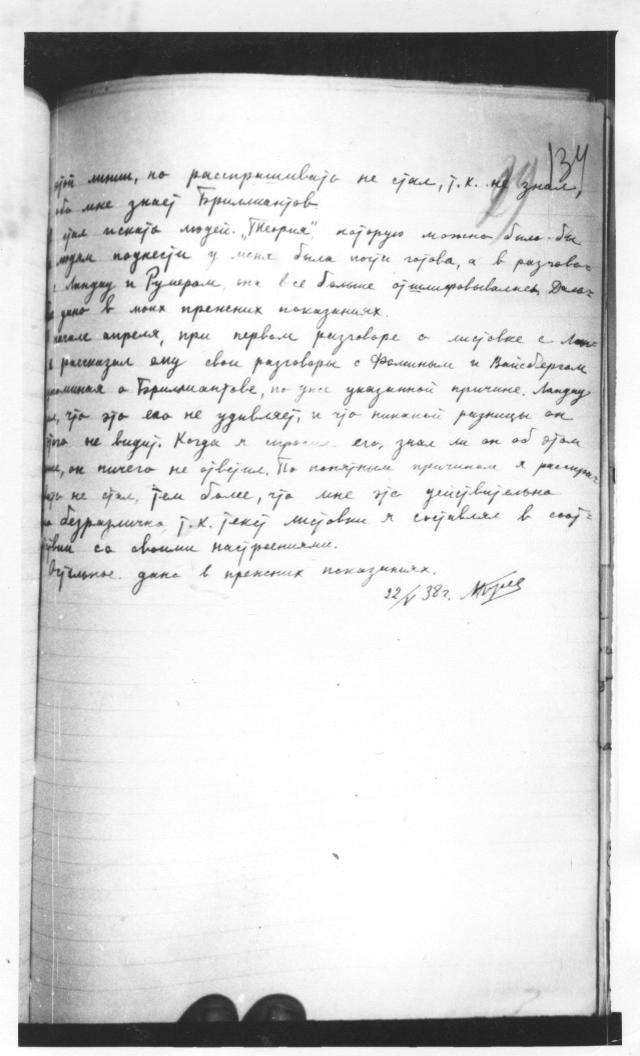
A reading of the photograph, uncertain in places. Check it against the photograph.
[illegible] of a name, but I did not start questioning, since [illegible]
[illegible] knows me Briliantov
[illegible] among people. "Theory", which one could
[illegible] bring under at [illegible] was almost ready, and in conversation
with Landau and Rumer it took shape more and more. [illegible]
[illegible] in my previous testimony.
[illegible] of April, at the first conversation about the leaflet with Lan-
[illegible] I told him my conversations with Fomin and Vaisberg
[illegible] about Briliantov, for the reason already indicated. Landau
[illegible], that this does not surprise him, and that any difference he
[illegible] does not see. When I asked him whether he knew of this
[illegible], he answered nothing. For certain reasons I storie-
[illegible] did not, the more so as to me this really
not [illegible], since the text of the leaflet I composed in accor-
dance with my own attitudes.
[illegible] is given in the previous testimony.
12/V 38. Korin
P. 135 Interrogation of 02.06.38 p. 136 p. 137 p. 138 p. 139
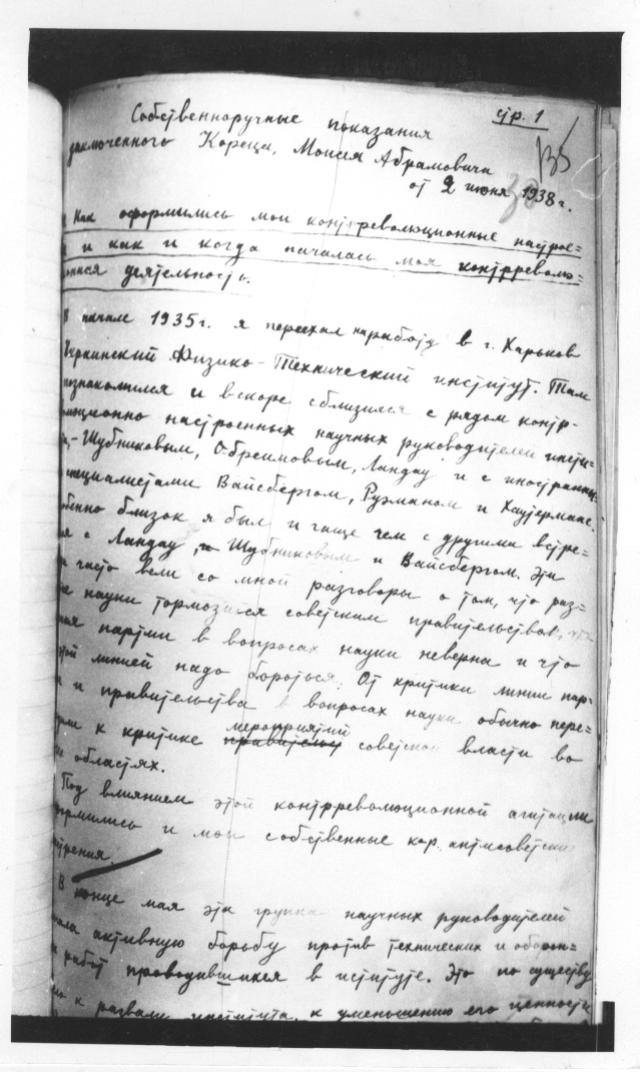
A reading of the photograph, uncertain in places. Check it against the photograph.
p. 1
Testimony in his own hand
of the arrested man Korets, Moisey Abramovich
of 2 June 1938
How my counterrevolutionary attitudes took shape
and how and when my counterrevolutionary
activity began.
In [illegible] 1935 I transferred to work in the city of Kharkov
the Ukrainian Physico-Technical Institute. There
[illegible] and soon drew close to a number of counter-
revolutionary-minded scientific leaders of the insti-
tute — Shubnikov, Obreimov, Landau and with for-
eign specialists Vaisberg, Rumer and Kaufman.
[illegible] I was close and more often than with the others I mee-
t with Landau, with Shubnikov and Vaisberg. These
[illegible] held conversations with me about how the deve-
lopment of science is held back by the Soviet government, that
[illegible] of the Party in questions of science is wrong and that
[illegible] one must fight. From criticism of the line of the Par-
ty and of the government in questions of science, usually they pas-
sed to criticism of the measures of the Soviet power in ge-
neral.
Under the influence of this counterrevolutionary agitation
[illegible] and my own counterrevolutionary
[illegible]
[illegible] my this group of scientific leaders
[illegible] a struggle against technical and [illegible]
[illegible] being carried out at the institute. This in essence
[illegible] [illegible] and to a lessening of its [illegible]
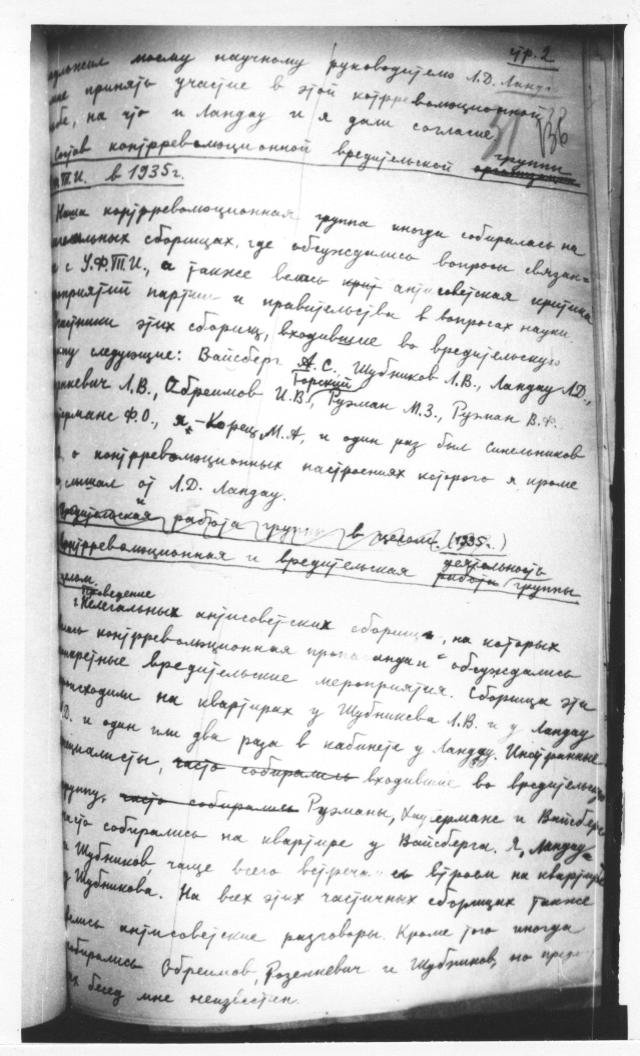
A reading of the photograph, uncertain in places. Check it against the photograph.
p. 2
[illegible]dineniyu to my scientific leader L.D. Landau.
[illegible] took part in this counterrevolutionary
[illegible]be, to which both Landau and I gave consent
[illegible]sov of a counterrevolutionary wrecking group
[illegible]TI. in 1935.
Our counterrevolutionary group sometimes gathered at
illegal meetings, where questions connected
with U.F.T.I. were discussed, and also c.-r. anti-Soviet criticism was conducted
of the measures of the Party and the government in questions of science.
The participants of these meetings, who belonged to the wrecking
group, the following: Vaisberg A.S. Shubnikov L.V., Landau L.D.,
[illegible]nevich L.V., Obreimov I.V., Gorsky, Ruzman M.Z., Ruzman V.F.
[illegible]ermane F.O., I, Korets M.F. and once there was Sinelnikov
[illegible] of whose counterrevolutionary attitudes I besides
[illegible]shal from L.D. Landau.
Wrecking work of the group in Kharkov (1935.)
Counterrevolutionary and wrecking activity of the work of the group
1. [illegible]vedeniye
Of illegal anti-Soviet meetings, at which
[illegible] counterrevolutionary propaganda and there were discussed
[illegible] wrecking measures. These meetings
took place at the apartments of Shubnikov L.V. and of Landau
[illegible]. and once or twice in Landau’s office. Foreigners
[illegible]mashey, often there gathered those who belonged to the wrecking
group, often there gathered the Ruzmans, Ruermane and Vaisberg
often gathered at Vaisberg’s apartment. I, Landau
and Shubnikov most often met the three of us at the apartment
of Shubnikov. At all these private meetings earlier
[illegible]lis anti-Soviet conversations. Besides that sometimes
[illegible]biralis Obreimov, Rozenkevich and Shubnikov, but prisut
[illegible] the conversation did not come off for me.
A reading of the photograph, uncertain in places. Check it against the photograph.
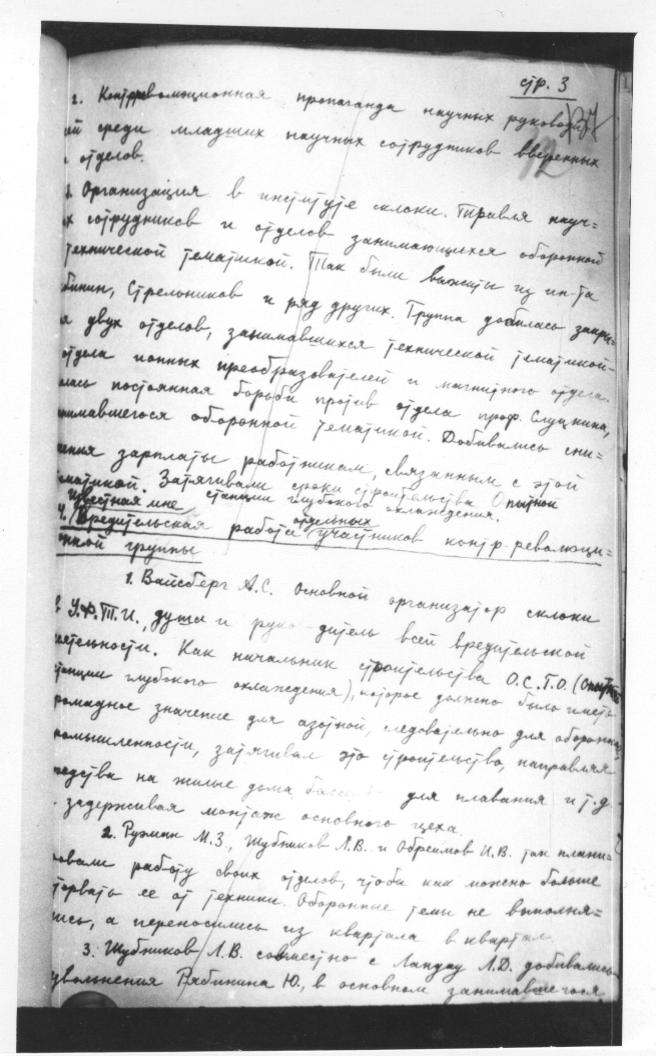
p. 3
2. Counterrevolutionary propaganda of the scientific leaders
[illegible]y among the junior scientific staff [illegible]
[illegible] of departments.
3. Organization of squabbling at the institute. Baiting of scien-
[illegible] staff and of departments engaged in defense
[illegible]cheskoy subject matter. Thus there were squeezed out of the inst.
[illegible]bin, Strelkovikov and a number of others. The group achieved the clos-
[illegible] of two departments engaged in technical subject matter
[illegible]dela of ion converters and of the magnetic department.
[illegible]las a constant struggle against the department of Prof. Slutskin,
engaged in defense subject matter. They sought a lowe-
[illegible] of pay for the workers connected with this
subject matter. They dragged out the periods of construction of the Experimental
station of deep cooling.
4. Wrecking work of individual participants of the counterrevolutio-
nary group
1. Vaisberg A.S. the chief organizer of the squabble
at U.F.T.I., souls and the leader of the whole wrecking
activity. As head of the construction of A.S.T.O. (the Experimental
station of deep cooling), which was to have
enormous significance for the nitrogen, consequently for the defense
industry, he dragged out this construction, directed
means to petty [illegible] for swimming and so on
delaying the assembly of the main shop.
2. Ruzman M.Z., Shubnikov L.V. and Obreimov I.V. so altered
[illegible]vali the work of their departments, so that [illegible] as much as possible
[illegible]rvala it from the regime. Defense themes were not carried out,
[illegible]lis, but were carried over from quarter to quarter.
3. Shubnikov L.V. together with Landau L.D. sought
the dismissal of Ryabinin Yu., engaged chiefly in [illegible]
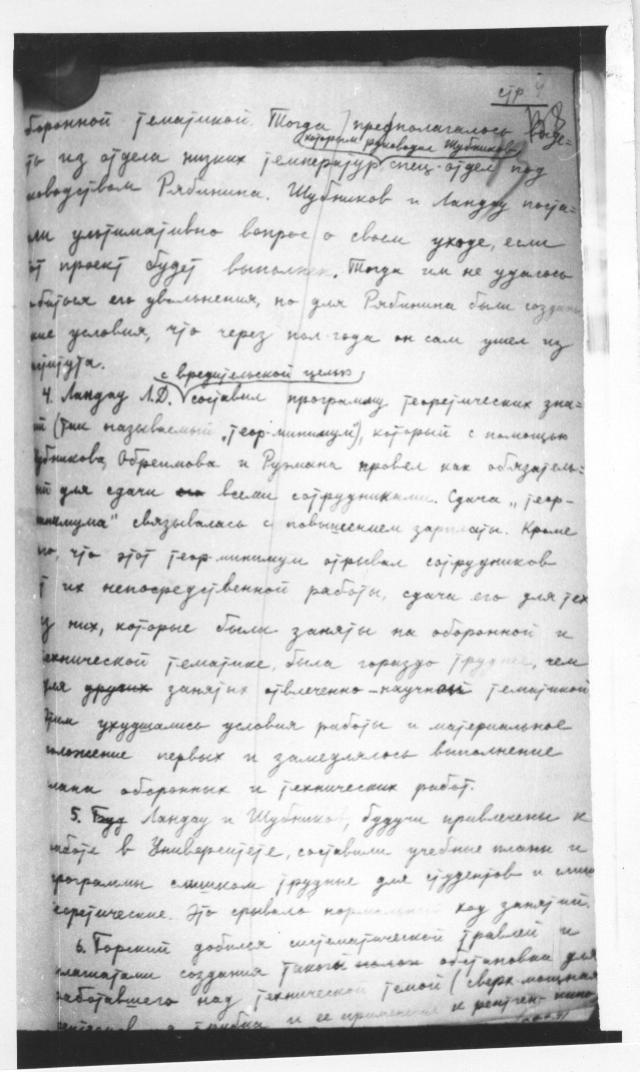
A reading of the photograph, uncertain in places. Check it against the photograph.
p. 4
[illegible]ronnoy subject matter. It was then supposed [illegible]
[illegible] from the low temperatures department a spec. department under
the leadership of Ryabinin. Shubnikov and Landau put
to him as an ultimatum the question of their own departure, if
this project were carried out. Then they did not manage
to achieve his dismissal, but for Ryabinin there were created
such conditions that after half a year he himself left
the institute.
4. Landau L.D. with a wrecking aim
drew up a program of theoretical studies
(the so-called "therm-minimum"), which with the help
of Shubnikov, Obreimov and Ruzman he carried through as obliga-
tory for all the staff to pass it. Passing the "therm-
minimum" was tied to a rise in pay. Besides
the fact that this therm-minimum tore the staff
away from their immediate work, passing it for those
of them who were engaged on defense and
technical subject matter was much harder than
for others engaged on social-scientific subject matter
with the worsening conditions of work and the material
position of the former and the fulfillment was slowed
of the plan of defense and technical work.
5. Being Landau and Shubnikov, being drawn to
work at the University, they drew up study plans with
[illegible] too difficult for the students and [illegible]
theoretical. This disrupted the normal [illegible] of studies.
6. Gorsky achieved an experimental baiting and
[illegible] of the creation [illegible] (over [illegible]
[illegible] over a technical theme ([illegible]
[illegible]
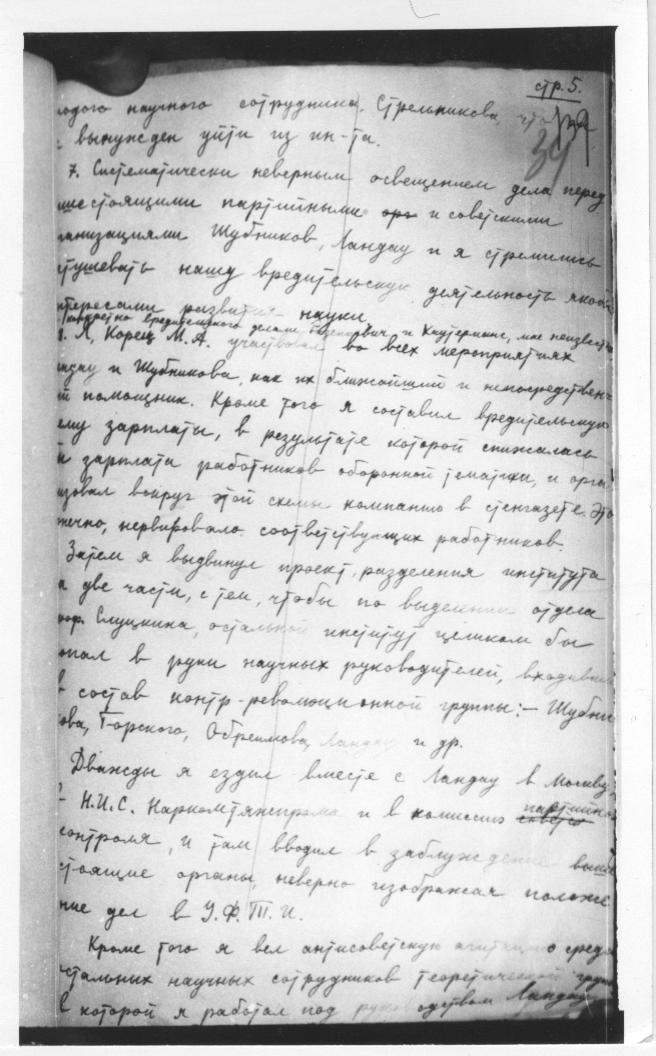
A reading of the photograph, uncertain in places. Check it against the photograph.
p. 5.
[illegible]nogo scientific staff member. Strelkovikov
[illegible] was forced to leave the inst.
7. By a systematically wrong presentation of the matter before
higher party org and Soviet
organizations Shubnikov, Landau and I sought
to cover our wrecking activity allegedly
[illegible] of the development of science.
8. I, Korets M.F. took part in all the measures
of Landau and Shubnikov, as their closest and immediate
helper. Besides that I drew up a wrecking
[illegible] of pay, as a result of which there was lowered
[illegible] the pay of workers on defense subject matter, and organ-
ized around this scheme a campaign in the wall newspaper. This
[illegible], put the corresponding workers on edge.
Then I put forward a project of dividing the institute
into two parts, so that upon the separation of the department
of Prof. Slutskin, to leave the institute wholly [illegible]
[illegible] in the hands of the scientific leaders who belonged
to the counter-revolutionary group: — Shubni-
kov, Gorsky, Obreimov, Landau and others.
Twice I went together with Landau to Moscow
to the N.I.S. of Narkomtyazhprom and to the commission of party
control, and there misled the higher-
standing bodies, incorrectly depicting the state
of affairs at U.F.T.I.
Besides that I conducted anti-Soviet agitation among
[illegible] scientific staff of the theoretical group
in which I worked under Landau’s leadership.
P. 140 p. 141 p. 142 p. 143 p. 144 p. 145 p. 146
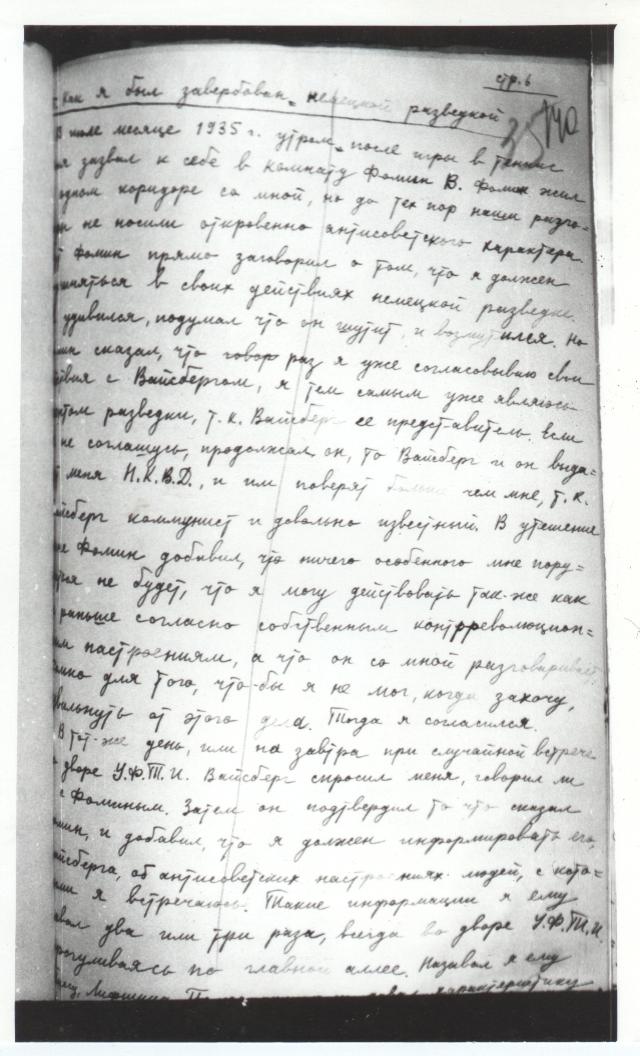
A reading of the photograph, uncertain in places. Check it against the photograph.
p. 6
[illegible] I was recruited by German intelligence
At the end of July 1935 in the morning, after a game of tennis
[illegible] Fomin V. came into his room. Fomin lived
in one corridor with me, but until then our conversations
[illegible] did not have a frankly anti-Soviet character.
Fomin spoke straight out of the fact that I must
[illegible] in my actions to German intelligence.
[illegible] was surprised, thought that he was joking, and was indignant. But
[illegible] said that, saying once, I had already coordinated my
[illegible] with Vaisberg, I thereby already am
[illegible] of intelligence, since Vaisberg is its representative. If
I do not agree, he went on, then Vaisberg and he will hand
me over to the N.K.V.D., and they will be believed [illegible] than me, since
Vaisberg is a communist and fairly well known. By way of consolation
Fomin added that nothing special would be ass-
igned to me, that I could act just as
before according to my own counterrevolution-
ary attitudes, and that he is talking with me
only so-that I would not be able, whenever I wished,
to refuse this business. Then I agreed.
That same day, or on the next day, at a chance meeting
in the yard of U.F.T.I. Vaisberg asked me whether
I had spoken with Fomin. Then he confirmed what
Fomin had said, and added that I must inform him,
Vaisberg, about the anti-Soviet attitudes of the people with wh-
om I meet. Such informations I
gave him two or three times, always in the yard of U.F.T.I.
limiting myself to the main [illegible]. I named to him
[illegible]
A reading of the photograph, uncertain in places. Check it against the photograph.
p. 7
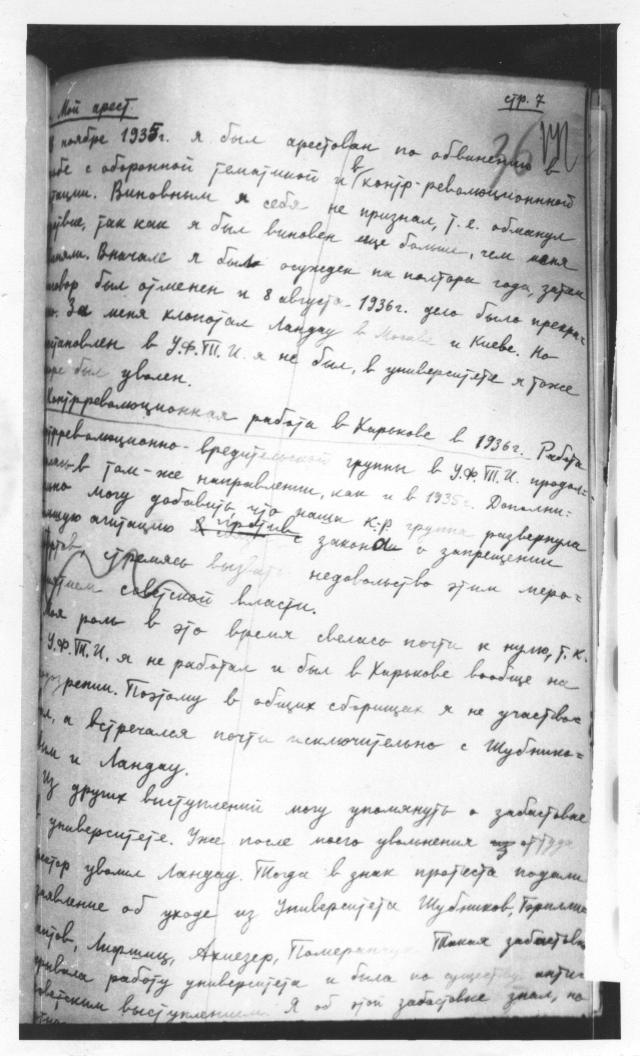
My arrest
In November 1935 I was arrested on a charge of
connection with defense subject matter and counter-revolutionary
[illegible]. I did not admit myself guilty, that is, I deceived
the investigation, since I was guilty still more than I was
[illegible]. At first I was sentenced to a year and a half, then
the sentence was quashed and on 8 August 1936 the case was discon-
tinued. Landau interceded for me in Moscow and in Kiev. But
I was not reinstated at U.F.T.I., at the university I too
was soon dismissed.
Counterrevolutionary work in Kharkov in 1936. The work
of the counterrevolutionary-wrecking group at U.F.T.I. contin-
ued in the same direction as in 1935. Addition-
ally I can add that our c.-r. group launched
a large agitation in connection with the law on the prohibition
of abortions, seeking to arouse discontent with this meas-
ure of the Soviet power.
My role at this time came down almost to zero, since
I was not working at U.F.T.I. and was in Kharkov in general on
[illegible]. Therefore I did not take part in the general meetings
and met almost exclusively with Shubnikov
and Landau.
Of other actions I can mention the strike
at the university. Already after my dismissal from [illegible]
[illegible] they dismissed Landau. Then as a sign of protest there submitted
a statement of leaving the University Shubnikov, Gorsky
[illegible], Lifshits, Akhiezer, Pomeranchuk. Such a strike
disrupted the work of the university and was in essence [illegible]
[illegible] an action. I knew of this strike, but
A reading of the photograph, uncertain in places. Check it against the photograph.
p. 8.
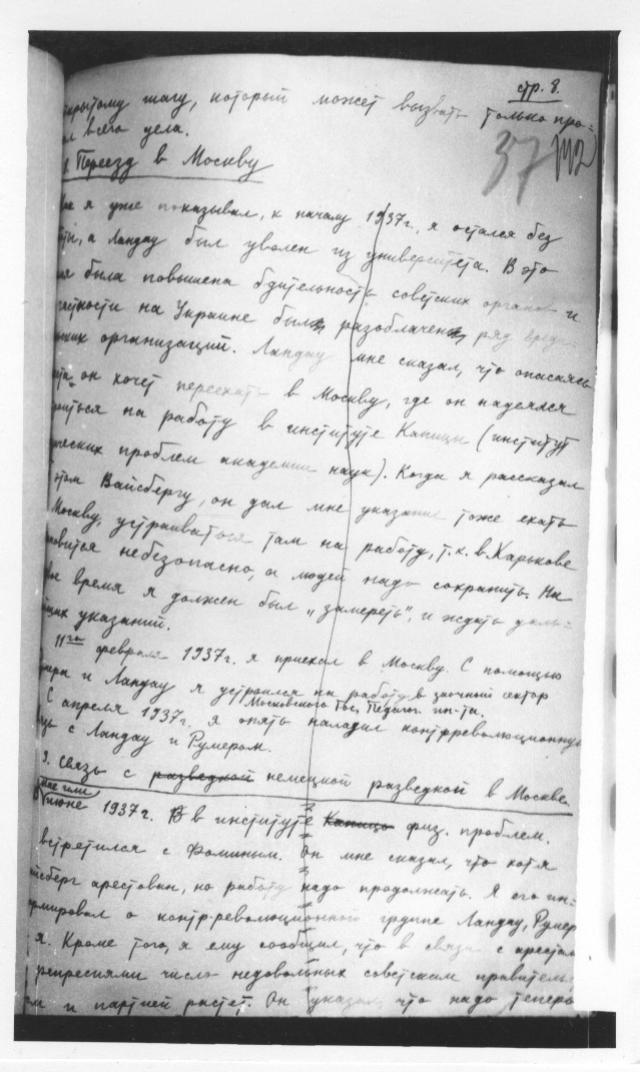
[illegible] a subject, which can cause only the fail-
ure of the whole affair.
Move to Moscow
As I have already testified, by the beginning of 1937 I was left without
work, and Landau had been dismissed from the university. At this
time the vigilance of the Soviet organs was raised and
counterrevolutionary organizations in Ukraine were exposed a number of other
[illegible] organizations. Landau told me that he fears
arrest and wants to move to Moscow, where he hoped
to get work at Kapitsa’s institute (the Institute
of Physical Problems of the Academy of Sciences). When I told
Vaisberg of this, he gave me an instruction to go too
to Moscow, to get work there, since in Kharkov
it was unsafe to remain, and people must be preserved. For
[illegible] a time I was to "freeze", and following direc-
tions.
On 11 February 1937 I arrived in Moscow. With the help
of Kapitsa and Landau I got work in the academic sector
[illegible] of the Mint [illegible]. of the Ped. inst.
From April 1937 I again established counterrevolutionary
contact with Landau and Rumer.
3. Contact with intelligence German intelligence in Moscow.
[illegible] June 1937. In in the Institute of Phys. Problems
I met Fomin. He told me that although
Vaisberg is arrested, the work must go on. I in-
formed him about the counterrevolutionary group of Landau, Rumer
and I. Besides that, I told him that in connection with the arrests
[illegible] many people discontented with the Soviet govern-
ment and the Party. He indicated that it was necessary [illegible]
A reading of the photograph, uncertain in places. Check it against the photograph.
p. 9
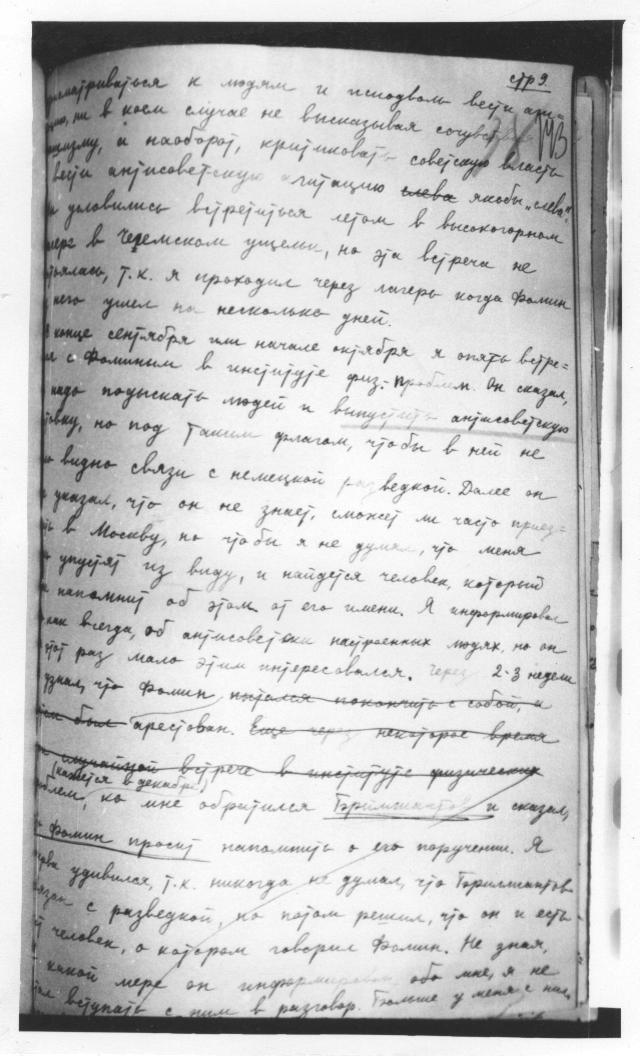
[illegible] to people and never [illegible]
[illegible], in no case expressed sympathy
[illegible], and on the contrary, criticized the Soviet power
[illegible] anti-Soviet agitation [illegible]
We agreed to meet in the summer at a high-mountain
camp in the Teberda gorge, but this meeting did not
take place, since I passed through the camp when Fomin
had already gone away for several days.
At the end of September or the beginning of October I again mee-
t with Fomin at the Institute of Phys. Problems. He said
that one must find people and put out an anti-Soviet
leaflet, but at such an angle that in it there would not
be visible a connection with German intelligence. Further he
indicated that he does not know whether he will often be able to co-
me to Moscow, but that I should not think that I
will be lost from sight, and a person will be found who
will remind me of this in his name. I informed
him always, about the anti-Soviet attitudes of people, but he
this time was little interested in this. After 2-3 weeks
I learned that Fomin [illegible] was arrested. After some more time
at the next meeting at the Institute of Physical
Problems, (it seems in December) [illegible], Torchinsky approached me and said
that Fomin had asked to remind me of his commission. I
at first was surprised, since I never thought that Torchinsky
was connected with intelligence, but then decided that he is
that person of whom Fomin had spoken. I do not know
to what extent he is informed about me, I did not
[illegible] into a conversation. I have no more with him
[illegible]
A reading of the photograph, uncertain in places. Check it against the photograph.
p. 10
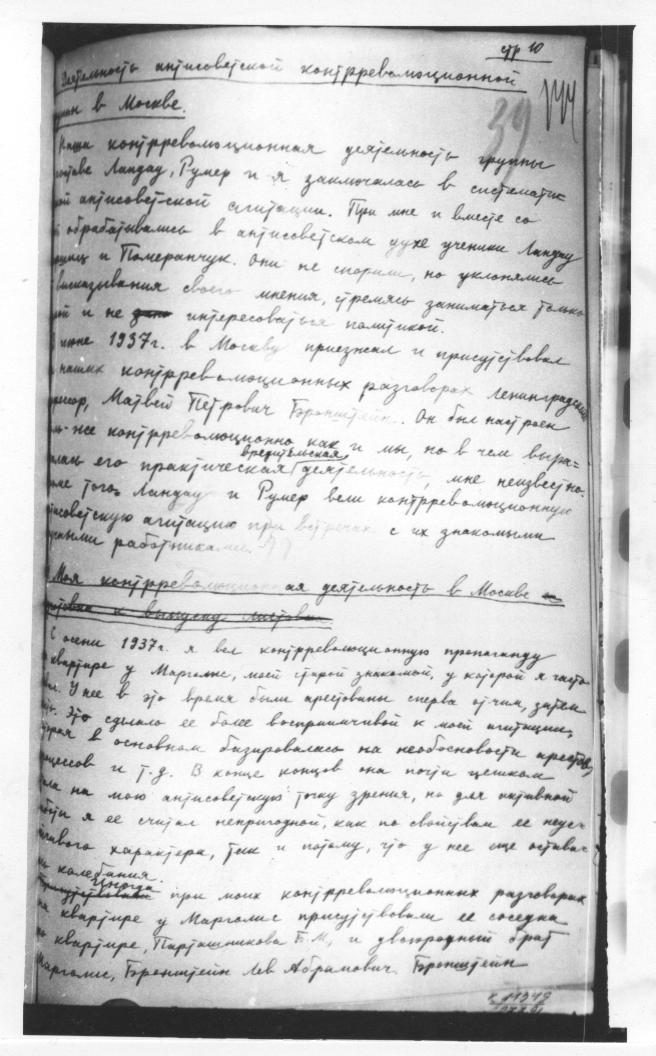
Activity of the anti-Soviet counterrevolutionary
group in Moscow.
Our counterrevolutionary vulnerability of the group
consisting of Landau, Rumer and I consisted in systema-
tic anti-Soviet agitation. In my presence and together with
me Landau’s pupils were worked on in an anti-Soviet spirit
[illegible] and Pomeranchuk. They did not argue, but avoided
stating their opinions, seeking to engage only
in science and not [illegible] to take an interest in politics.
In the summer of 1937 there came to Moscow and was present
at our counterrevolutionary conversations a Leningrad
physicist, Matvey Petrovich Bronshtein. He was minded
anti-Sovietly counterrevolutionary as we were, but in what was expres-
sed his practical wrecking activity, I do not know.
Besides that Landau and Rumer conducted counterrevolutionary
anti-Soviet agitation at meetings with their acquaintance
scientific workers.
My counterrevolutionary activity in Moscow
[illegible]
From the autumn of 1937 I conducted counterrevolutionary propaganda
at the apartment of Margalis, an old acquaintance of mine, at whose I then
lived. Already at this time there were arrested first one, then
others. This made her more receptive to my agitation,
which was based chiefly on the groundlessness of the arrests
of scientists and so on. In the end she almost entirely
took up my anti-Soviet point of view, but for active
work I considered her unfit, both by the qualities of her irreso-
lute character, and because she still had
[illegible] vacillations.
Sometimes at my counterrevolutionary conversations
at Margalis’s apartment there were present her neighbor
in the apartment, Parfennikova E.M., and a cousin
of Margalis, Bronshtein Lev Abramovich. Bronshtein
A reading of the photograph, uncertain in places. Check it against the photograph.
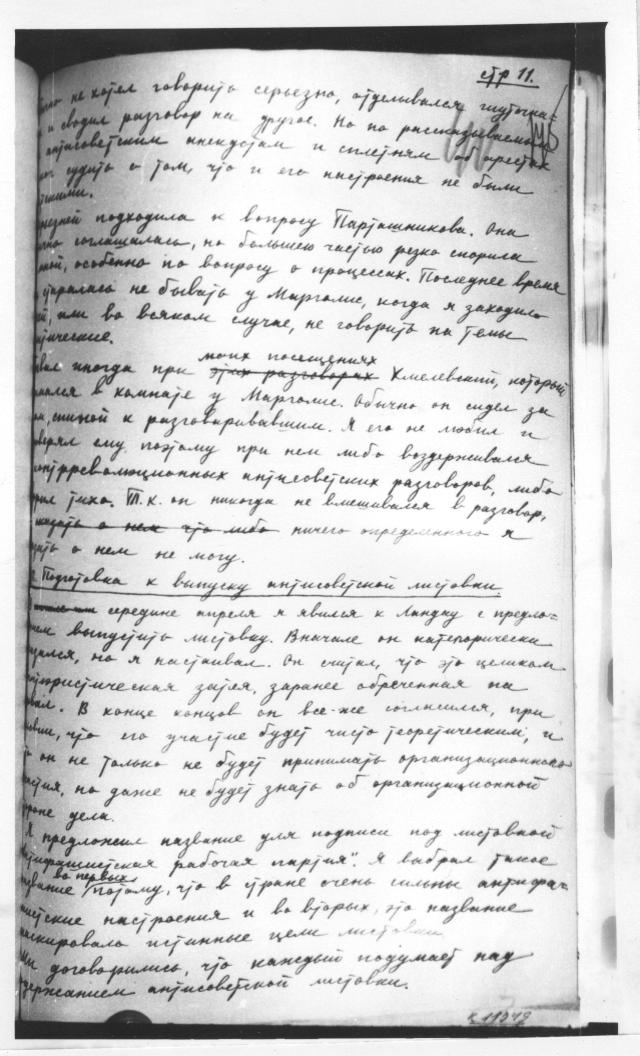
p. 11.
[illegible] did not always speak seriously, laughed it off [illegible]
and turned the conversation onto something else. But by the
anti-Soviet anecdotes he uttered and the skeptical [illegible]
I judged that his attitude too was not
[illegible].
[illegible] Parfennikova approached the question. She
[illegible] agreed, but for the most part rarely argued
with me, especially on the question of the trials. Lately
I tried not to be at Margalis’s, when I stopped
by her, then in any case I did not speak of such
[illegible].
[illegible] sometimes at my visits [illegible] Kiselevsky, who
[illegible] in the room at Margalis’s. Usually he sat over
[illegible] a book and talked little. I did not like him and
[illegible] to him therefore in his presence either refrained
from counterrevolutionary anti-Soviet conversations, or
spoke quietly. Since he never joined in the conversation,
[illegible] nothing definite I
cannot say about him.
Preparation for putting out an anti-Soviet leaflet.
[illegible] the middle of April I came to Landau with a propo-
sal to put out a leaflet. At first he categorically
objected, but I insisted. He said that this is too
adventurist an undertaking, doomed beforehand to
failure. In the end he nevertheless agreed, on
condition that his participation would be purely theoretical, and
that he not only would not take organizational
participation, but would not even know of the organizational
side of the business.
I proposed a name for the signature under the leaflet
"antifascist workers’ party". I chose such
a name first because in the country antifa-
scist attitudes are very strong and second, this name
masked the true aims of the leaflet
[illegible] an agreement that each would think over
the content of the anti-Soviet leaflet.
A reading of the photograph, uncertain in places. Check it against the photograph.
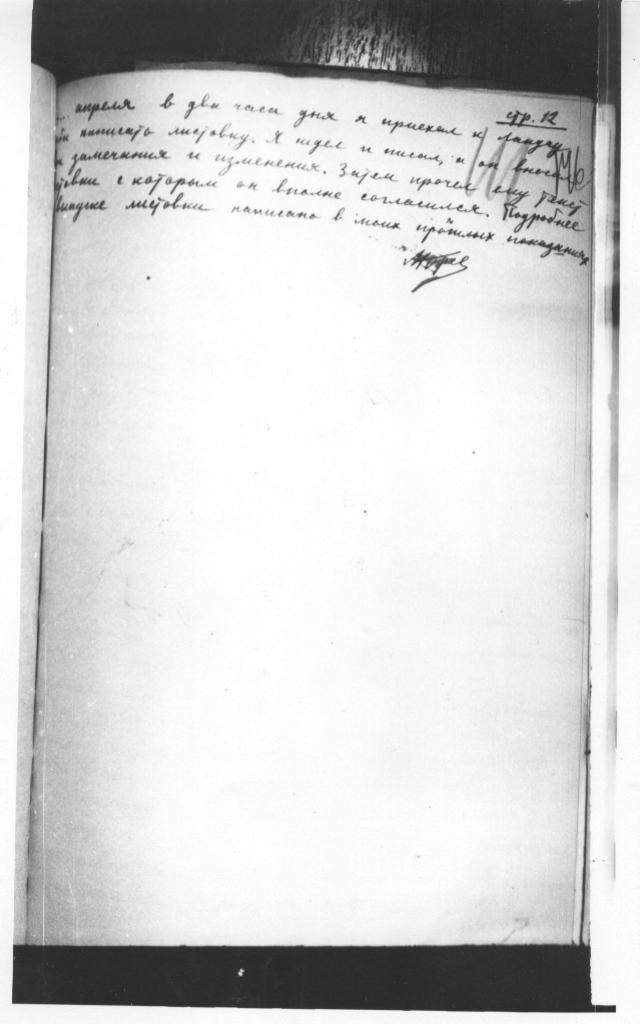
p. 12
[illegible] of April at two o’clock in the afternoon I came to Landau
and brought the leaflet. I waited and wrote, and he introduced
a number of remarks and changes. Then I read him the text
of the leaflet with which he fully agreed. In more detail
about [illegible] the leaflet is written in my previous testimony.
[illegible]
P.152 Interrogation of 07(?).06.38, third page
A reading of the photograph, uncertain in places. Check it against the photograph.
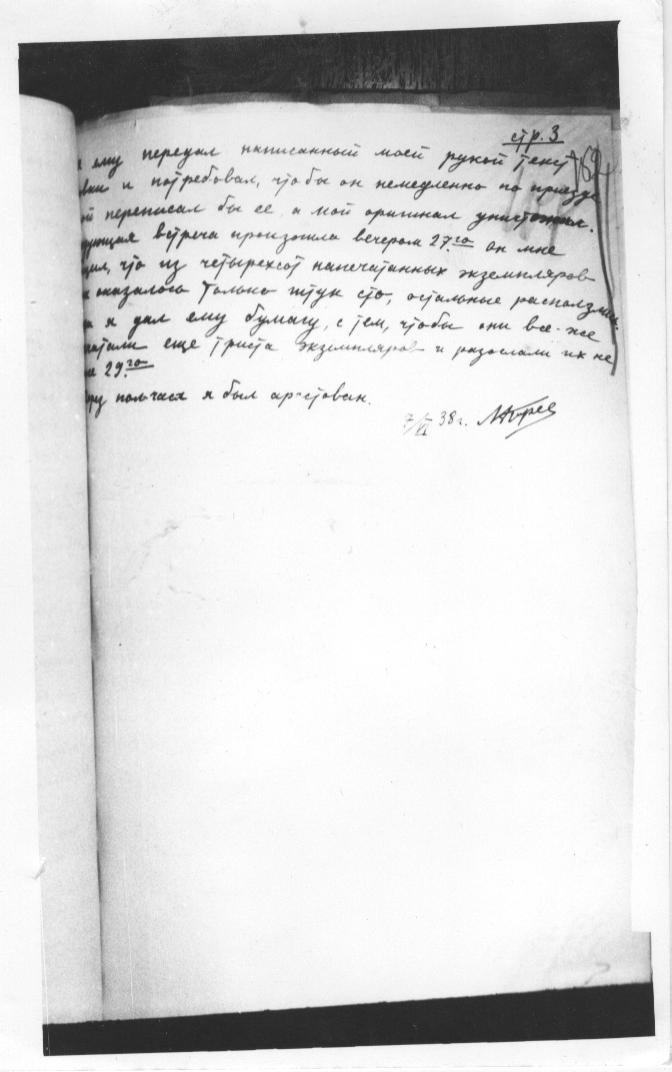
p. 3
[illegible] handed over the text written in my hand [illegible]
[illegible] and demanded that he immediately upon arrival
in [illegible] should rewrite it, and destroy my original.
The next meeting took place on the evening of the 27th [illegible] he
told me that of four copies written
in [illegible] only three, the rest he scattered
[illegible] and gave him paper, so that they nevertheless
[illegible] three more copies and send them out no
later than the 29th.
[illegible] half an hour I was arrested.
7/VI 38. [illegible]
P. 148 Interrogation of 14.06.38 (from the second page) p. 149
A reading of the photograph, uncertain in places. Check it against the photograph.
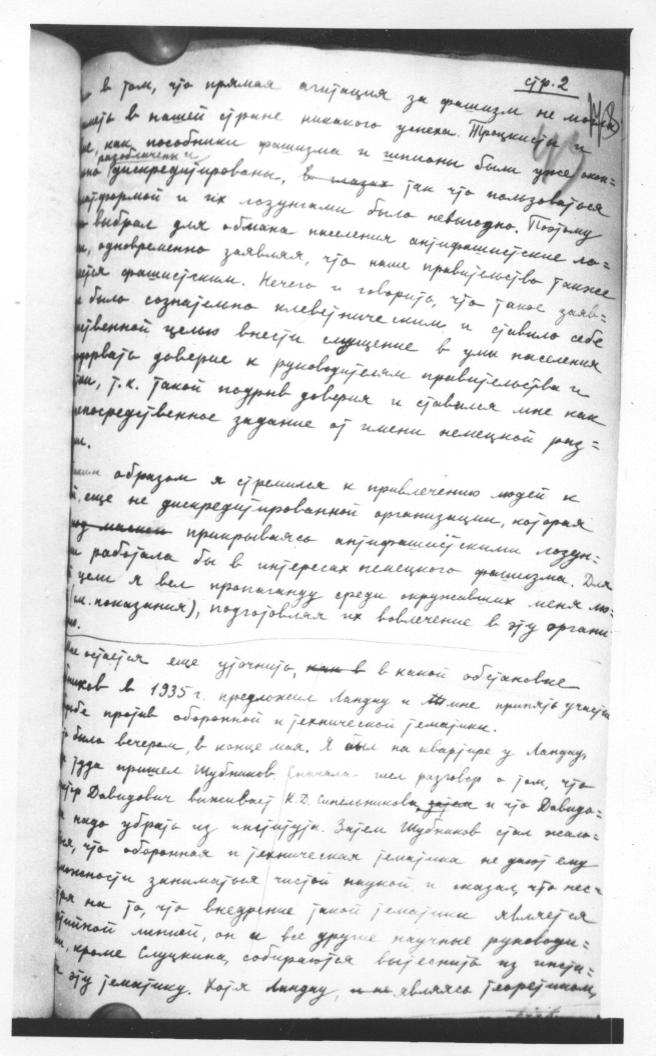
p. 2
[illegible] in that direct agitation for fascism cannot
have any success in our country. The Trotskyists and
[illegible], as accomplices of fascism and spies, had already been so-
much discredited, in the eyes of [illegible] that to use
[illegible] and their slogans was unprofitable. Therefore
an antifascist slo-
gan was chosen for deceiving the population, at the same time declaring that our government hel-
ps fascist ones. It goes without saying that such a state-
ment was deliberately slanderous and set itself
a definite aim of bringing confusion into the minds of the population
and of undermining trust in the leaders of the government and
of the Party, since such an undermining of trust and of confusion to me as
a direct assignment in the name of German intel-
ligence.
[illegible] manner I sought to draw people to
[illegible] an organization not yet discredited, which
[illegible] while covering itself with antifascist slo-
gans would work in the interests of German fascism. For
this aim I conducted propaganda among the people around me
(see the testimony), preparing their drawing into this organi-
zation.
[illegible] I will specify further, [illegible] in what setting
[illegible] in 1935 the proposal of Landau and [illegible] I took part
in the struggle against defense and technical subject matter.
[illegible] in the evening, at the end of May, I was at Landau’s apartment,
where Shubnikov came. At first there was a conversation about how
Professor Davidovich is squeezing out K.D. Sinelnikov [illegible] and that Davido-
vich must be removed from the institute. Then Shubnikov began to com-
plain that defense and technical subject matter do not give him
a possibility of engaging in pure science and said that des-
pite the fact that the introduction of such subject matter is
the Party line, he and all the other scientific lea-
ders, except Slutskin, are going to boycott this subjec-
t matter. Besides Landau, [illegible] was a theoretician
A reading of the photograph, uncertain in places. Check it against the photograph.
p. 3.
[illegible] was engaged with this subject matter, but if it will
[illegible] a significant place in the inst., then his significance too [illegible]
[illegible] ruko will fall, therefore he too must and I, as his
closest staff member, must take part in this
struggle. We agreed, although we clearly understood that such
a struggle is a struggle against the line of the Party.
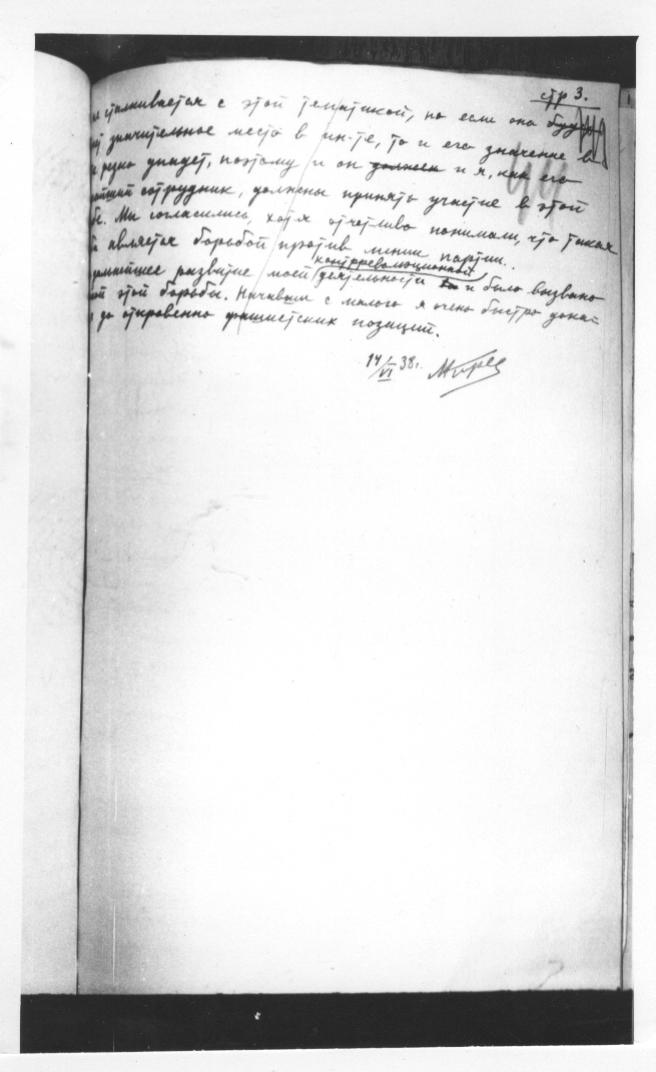
[illegible] the development of my counterrevolutionary activity [illegible] and was caused
by this struggle. Having begun from something small I very quickly came
to frankly fascist positions.
14/VI 38. [illegible]
A reading of the photograph, uncertain in places. Check it against the photograph.
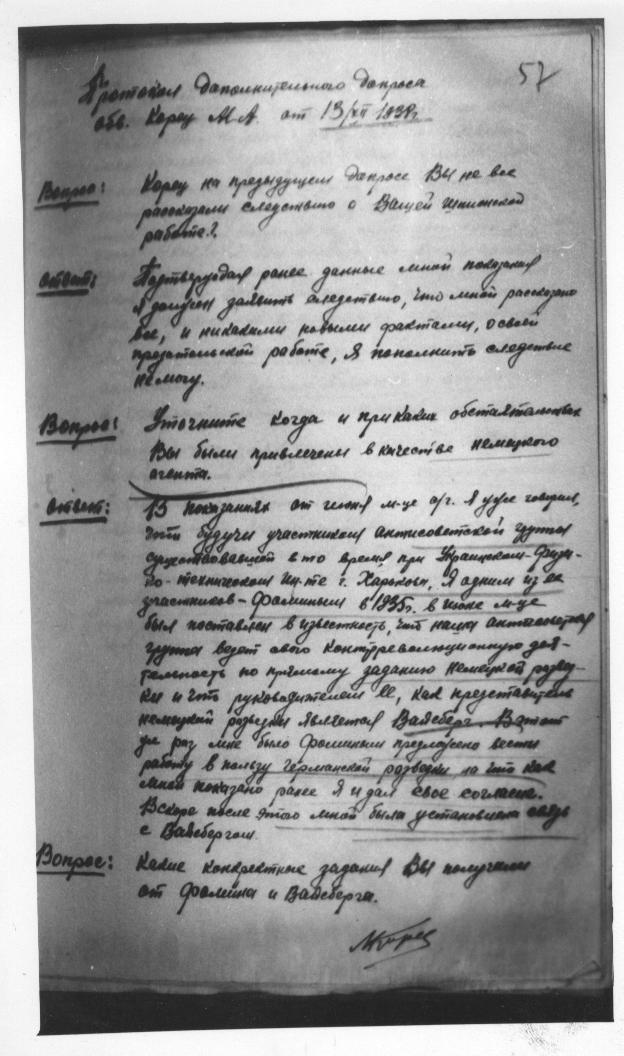
52
Record of the Additional Interrogation
acc. Korets M.F. of 13/XI 1938
Question: Korets, at the previous interrogation you did not tell
the investigation everything about your espionage
work?
Answer: Confirming the testimony I gave earlier
I must declare to the investigation that by me there has been told
everything, and no new [illegible], especially
[illegible] work, I additional to the investigation
do not have.
Question: Tell us when and under what circumstances
you were drawn in as a German
agent.
Answer: [illegible] I have already said
that I would be a participant of an anti-Soviet group
that existed at that time at the Ukrainian Physi-
co-Technical Inst. of the city of Kharkov. I by one of its
participants — by Fomin in 1935 at the end of July
was informed that our anti-Soviet
group conducts its counterrevolutionary acti-
vity on the direct assignment of German intelli-
gence and that its leader, as a representative
of German intelligence, is Vaisberg. A se-
cond time I was offered by Fomin to conduct
work in favor of the intelligence of Germany, to which as
[illegible] earlier I did give my consent.
Soon soon this same thing was established by me further
with Vaisberg.
Question: What concrete assignments did you receive
from Fomin and Vaisberg.
[illegible]
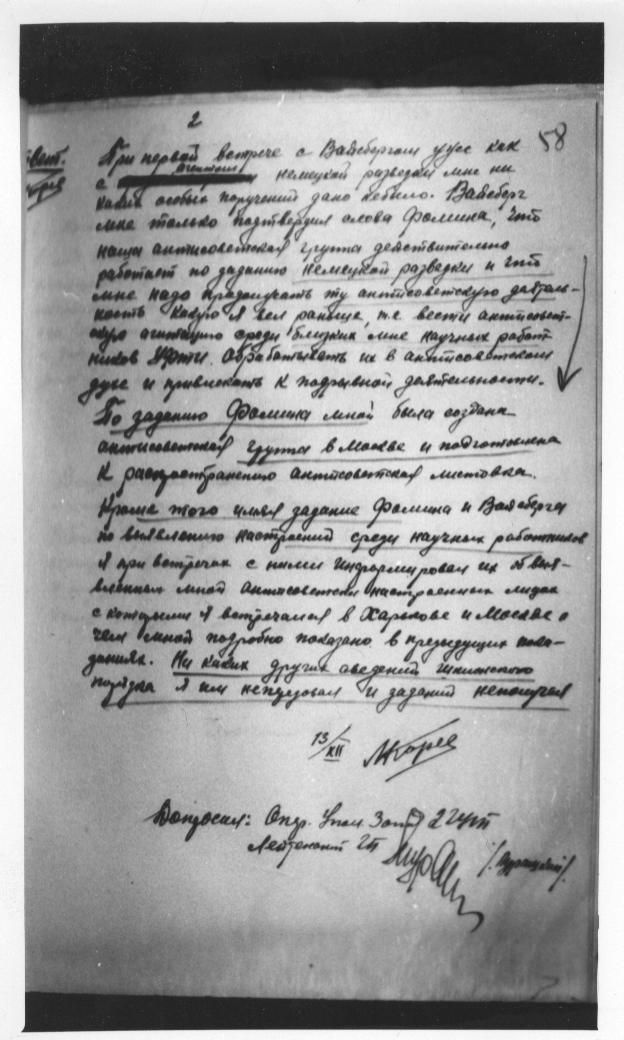
2
58
[in the margin] [illegible]
At the first meeting with Vaisberg already as
with [crossed out: [illegible]] this time, the latter told me not
any special assignments had been given. Vaisberg
only confirmed to me Fomin’s words, that
our anti-Soviet group really
works on an assignment of German intelligence and that
I must continue that anti-Soviet acti-
vity which I had carried on before, that is, carry on antisovi-
et agitation among the scientific wor-
kers of UFTI close to me. Obligatorily them in an anti-Soviet
spirit and draw them into subversive activity.
On Fomin’s assignment there was created by me
an anti-Soviet group [illegible] and prepared
for the distribution of an anti-Soviet leaflet.
Besides that I had an assignment of Fomin and Vaisberg
to uncover attitudes among scientific workers
and at meetings with them informed them of the iden-
tified by me anti-Sovietly minded persons
with whom I met in Kharkov and in Moscow about
which I have shown in detail in previous testi-
mony. Not any other information of an intimate
order did I pass to them. On an assignment of German
13/XII Korets
Questions: Oper. auth. of the 3rd sec. of the 2nd sec. of the GUGB
lieutenant of the GB [signature] /Muravyov/
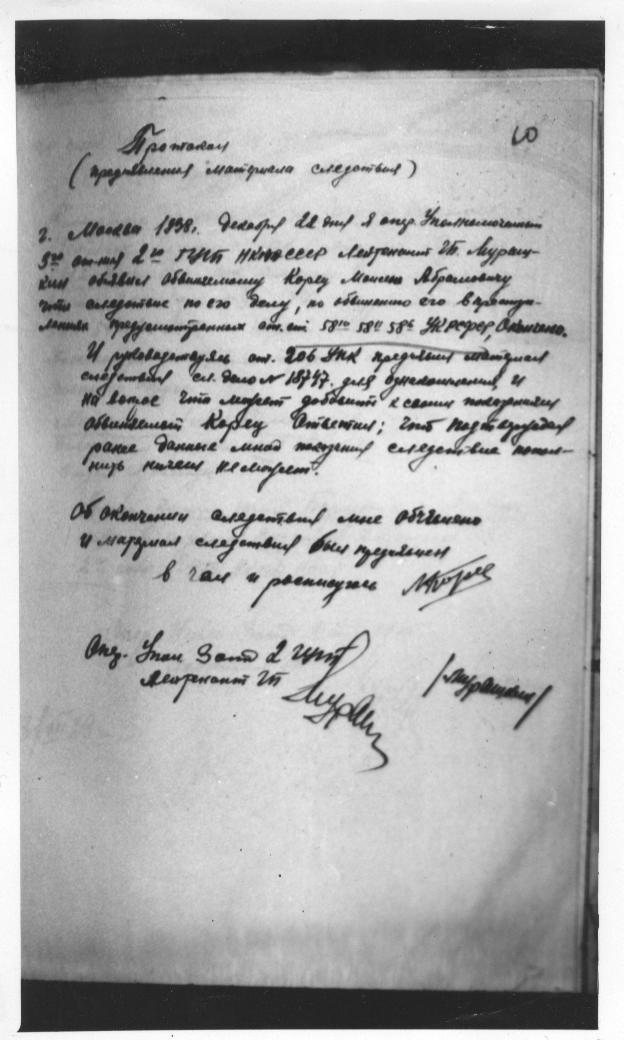
P.60 Record of the presentation of the investigation materials
Record
(of the presentation of the investigation material)
60
The city of Moscow, 22 December 1938. I, oper. authorized officer
of the 3rd sec. of the 2nd sec. of the GUGB of the NKVD of the USSR, lieutenant of the GB Muravyov
announced to the accused Moisey Abramovich Korets
that the investigation of his case, on the charge against him of [illegible]
provided for by Arts. 58-10, 58-11 of the Criminal Code of the RSFSR, is finished.
And guided by Art. 206 of the Code of Criminal Procedure presented the material
of the investigation, the foll. case No. 13749, for acquaintance and
to the question what he can add to his testimony
the accused Korets answered: that I confirm
the testimony I gave earlier to the investigation [illegible]
I have nothing.
The end of the investigation has been announced to me
and the material of the investigation has been presented to me
which I sign Korets
Oper. auth. of the 3rd sec. of the 2nd sec. of the GUGB
lieutenant of the GB [signature] /Muravyov/
The text is taken from photographs of the file. Words that could not be made out are marked [illegible]. Where a page is too faint, only the photograph is left.